We handle permits, inspections, utility coordination, demolition, and cleanup — so you don’t have to stress or guess

Cost per Square Foot for Double-Wide Mobile Home Removal
What affects double-wide mobile home demolition cost? Learn how size, contents, access, slabs, utilities and disposal affect pricing in Beaumont and Houston.
MOBILE HOME DEMOLITION
1/30/20267 min read
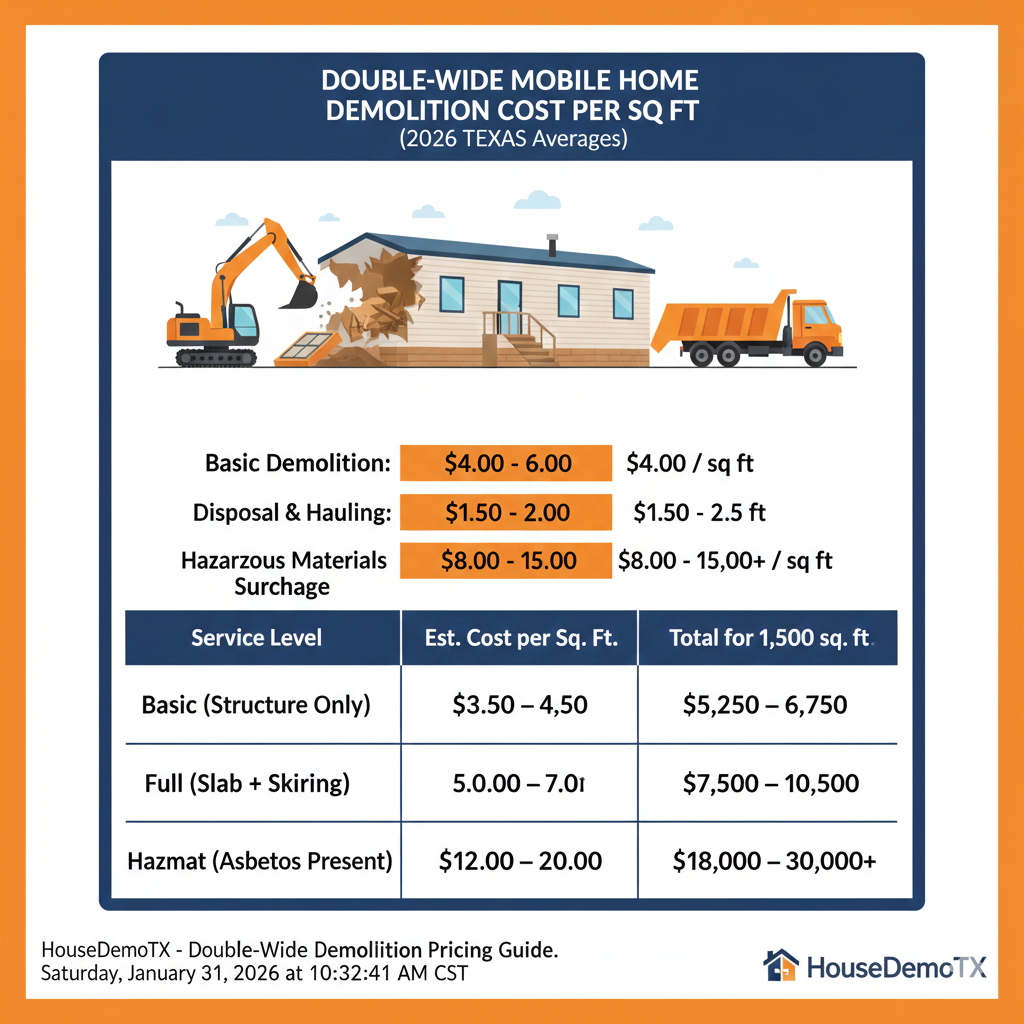
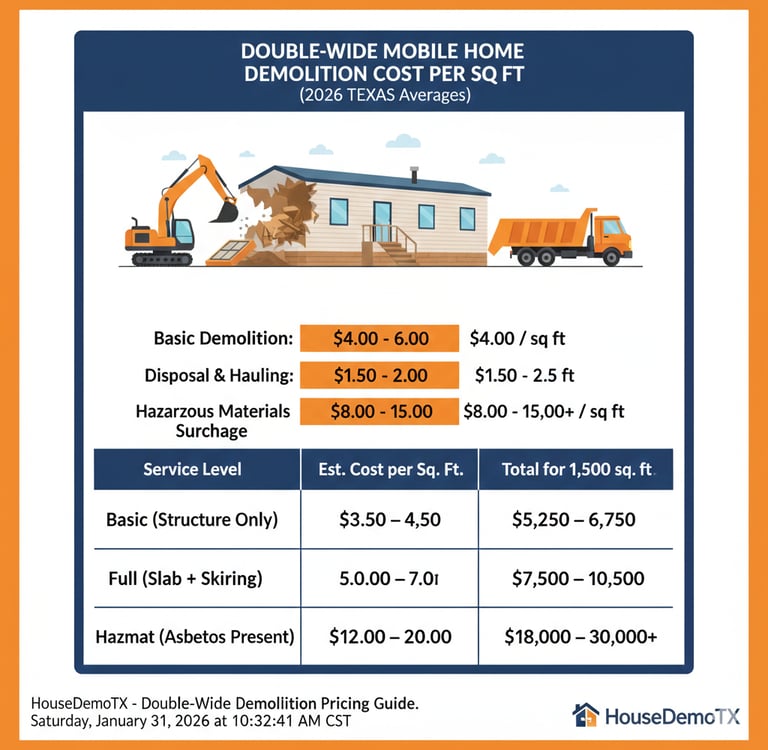
How Much Does Double-Wide Mobile Home Demolition Cost?
One of the first questions property owners ask about an old manufactured home is:
How much does it cost to demolish and remove a double-wide mobile home?
There is no reliable one-size-fits-all price.
Square footage matters, but it is only one part of the estimate. Two double-wide homes with the same dimensions can have very different demolition costs depending on the amount of material inside the home, porches and additions, equipment access, utility status, foundation type, debris volume and what the property owner wants the site to look like when the work is finished.
HouseDemoTX provides mobile home demolition and removal primarily throughout Beaumont and Southeast Texas, with selected projects throughout Greater Houston.
This guide explains the factors that determine double-wide demolition cost and what information helps produce a more accurate estimate.
Is Double-Wide Mobile Home Demolition Priced Per Square Foot?
Sometimes square footage is used as a rough starting point, but cost per square foot is not a dependable way to price an entire demolition project by itself.
A contractor still has to account for:
Structure size
Construction materials
Contents left inside
Porches and decks
Room additions
Skirting
Attached carports
Concrete slabs or runners
Equipment access
Utility status
Debris volume
Hauling distance
Disposal requirements
Site cleanup
Final grading
Desired condition of the property after demolition
That means a clean, accessible double-wide on an open lot may be considerably easier to remove than a smaller home surrounded by fences, trees, additions and accumulated contents.
For an accurate estimate, the entire property should be evaluated rather than multiplying square footage by a generic dollar amount.
What Determines the Cost of Double-Wide Mobile Home Demolition?
1. Size of the Mobile Home
A larger structure generally produces more demolition debris.
Double-wide manufactured homes also contain more:
Framing
Roofing
Siding
Flooring
Insulation
Interior finishes
Fixtures
than comparable single-wide homes.
More material can mean additional loading, hauling and disposal.
But size alone does not determine the final price.
2. Contents Left Inside the Home
A vacant mobile home is different from one filled with:
Furniture
Appliances
Mattresses
Clothing
Household trash
Stored materials
Abandoned personal belongings
Contents add volume and can increase the amount of labor, hauling and disposal required.
When requesting an estimate, tell the contractor whether the structure is:
Completely empty
Partially furnished
Heavily filled with contents
Photos of the interior can help establish the scope before equipment arrives.
3. Porches, Decks and Room Additions
Many older double-wide homes have structures added over time.
Examples include:
Front porches
Rear decks
Covered patios
Carports
Storage rooms
Utility rooms
Site-built additions
Wheelchair ramps
These additions are part of the demolition scope if they also need to be removed.
A 1,500-square-foot manufactured home with several additions can therefore require substantially more work than the home's original dimensions suggest.
4. Skirting and Exterior Materials
Mobile-home skirting can consist of:
Vinyl
Metal
Wood
Masonry
Concrete products
Other materials
Exterior construction affects how the structure is dismantled and the type of debris that must be handled.
The estimate should account for the actual materials present on the property.
5. Chassis, Frame and Manufactured-Home Components
Manufactured homes are constructed differently from conventional site-built houses.
A demolition scope may need to address:
Steel framing
Axles
Hitch components
Structural supports
Tie-down systems
Blocks or piers
The condition of these components and whether they are being removed as part of the project can affect the work required.
6. Concrete Slabs, Runners, Piers and Blocks
One of the most important questions is:
What should happen to the foundation material after the mobile home is gone?
Some properties have:
Full concrete slabs
Concrete runners
Piers
Blocks
Pads
Porches poured on concrete
Removing these materials creates a different scope than simply removing the manufactured home.
Before accepting a demolition estimate, determine whether the quote includes:
Mobile-home removal only
Concrete removal
Pier/block removal
Slab removal
Final grading
For a deeper explanation, read:
Do You Need to Remove the Concrete Slab After Mobile Home Demolition?
7. Equipment Access
Access can have a major impact on demolition cost.
An open property where equipment can easily reach the structure is very different from a site with:
Narrow gates
Fences
Trees
Neighboring buildings
Low utility lines
Soft ground
Tight driveways
Septic components
Limited truck access
Restricted access may require additional planning or smaller equipment.
For an example of how access conditions affect demolition planning, see:
How We Get Heavy Machinery Into Small Backyards
8. Utility Status
Before demolition begins, applicable utilities must be addressed appropriately for the property and jurisdiction.
These can include:
Electricity
Natural gas
Propane
Water
Sewer
Septic systems
Communications lines
Do not assume that switching off a breaker or closing a valve means all demolition-related utility requirements have been satisfied.
Utility status should be identified during project planning.
Related resource:
Texas Homeowner Utility Disconnect Checklist
9. Debris Volume and Disposal
A large portion of a demolition project involves what happens after the structure comes down.
Materials still need to be:
Loaded
Transported
Handled appropriately
Removed from the property
A double-wide containing substantial household contents or multiple additions will generally generate more material than a clean, empty structure.
That is another reason generic cost-per-square-foot pricing can be misleading.
10. Fire, Storm or Structural Damage
A damaged manufactured home may require a different approach than an intact structure.
Properties affected by:
Fire
High winds
Storm damage
Falling trees
Long-term abandonment
Structural collapse
may involve unstable materials, additional debris or insurance documentation.
If the property was damaged by a storm and insurance may be involved, see:
Will Homeowners Insurance Cover Mobile Home Demolition After Storm Damage?
Coverage depends on the individual policy and cause of loss, so property owners should confirm coverage with their insurer or adjuster.
11. What You Want the Property to Look Like Afterwards
A demolition estimate should clearly define the finished scope.
Possible outcomes include:
Structure removed
Debris hauled away
Foundation left in place
Foundation removed
Property rough graded
Site prepared for additional work
Those are not all the same project.
Tell the contractor what you intend to do with the property after demolition.
For example:
Sell the land
Install another manufactured home
Build a site-built house
Keep the property vacant
Landscape it
Prepare it for another use
Your future plans can affect what should be removed during the demolition.
Preparing for Another Manufactured Home
If you intend to install another manufactured home after demolition, think beyond simply removing the old structure.
The property may need evaluation for:
Remaining concrete
Old runners or blocks
Debris
Utility locations
Drainage
Access
Grading
New installation requirements
The demolition contractor should not automatically promise that a site is approved or engineered for a new manufactured home unless that scope is actually being provided.
For planning considerations, read:
Preparing Your Lot for a New Manufactured Home After Demolition
What If the Mobile Home Has Been Abandoned?
Abandoned manufactured homes can create additional questions.
Before demolition, the property owner may need to determine:
Who owns the structure
Whether ownership records exist
Whether the home is still titled or documented
Whether a tenant or previous occupant left property inside
Whether local requirements apply before removal
Do not assume that owning the land automatically resolves every question involving an abandoned manufactured home.
For more information:
Abandoned Mobile Homes: How Landlords and Property Owners Can Approach Demolition
Single-Wide vs. Double-Wide Demolition Cost
Double-wide mobile homes will often require a larger demolition scope than single-wides because they generally contain more material.
But a double-wide is not automatically twice the cost.
For example, an empty double-wide with excellent equipment access can sometimes be more straightforward than a heavily modified single-wide with:
Multiple additions
Large porches
Concrete work
Limited access
Large amounts of debris
The correct comparison is based on the entire scope of work, not just the label “single-wide” or “double-wide.”
How to Get a More Accurate Double-Wide Demolition Estimate
The more information you provide at the beginning, the easier it is to establish the correct scope.
Send:
Property Address
This helps identify the location and likely jurisdiction.
Exterior Photos
Photograph:
Front
Rear
Both sides
Equipment-Access Photos
Show:
Driveway
Gates
Fences
Trees
Nearby structures
Route equipment would use to reach the home
Interior Photos
If safe to enter, show whether significant contents remain inside.
Approximate Size
Provide:
Length
Width
Approximate square footage, if known
Additions
Tell the contractor about:
Decks
Porches
Carports
Extra rooms
Sheds or attached structures
Foundation Information
If known, indicate whether the home sits on:
Blocks
Piers
Concrete runners
Full slab
Another system
Utility Status
Tell the contractor what you know about:
Power
Gas
Water
Sewer
Septic
Final Property Condition
Explain whether you want:
Home removed only
Foundation removed
Debris cleared
Site graded
Additional site preparation
This information produces a much better estimate than simply asking:
“What do you charge per square foot?”
Beaumont & Southeast Texas Double-Wide Demolition
Beaumont and Southeast Texas are HouseDemoTX's primary service area.
For local service information, see:
Mobile Home Demolition in Beaumont, TX
HouseDemoTX also has documented mobile-home demolition work in Southeast Texas.
See:
Nederland Double-Wide Mobile Home Demolition Project
The project gallery contains additional examples of demolition work:
Greater Houston Double-Wide Demolition
HouseDemoTX also accepts selected mobile-home demolition projects throughout Greater Houston.
Houston-area properties can differ considerably in:
Jurisdiction
Equipment access
Lot size
Utility configuration
Disposal requirements
Existing additions
Intended site use
For local service information:
Mobile Home Demolition in Houston, TX
Why We Don't Publish One Universal Double-Wide Price
A generic advertised price may be attractive, but it can also create unrealistic expectations.
Consider two properties:
Property A
Empty double-wide
Open rural-style access
No porch
No addition
Minimal remaining contents
Foundation scope clearly defined
Property B
Same square footage
Furniture and debris inside
Large covered porch
Added room
Concrete work
Fence removal needed for access
Tight neighboring structures
Those homes may have the same number of square feet, but they do not represent the same demolition project.
A site-specific estimate is more useful than an arbitrary cost-per-square-foot number.
Frequently Asked Questions About Double-Wide Demolition Cost
How much does it cost to demolish a double-wide mobile home?
The cost depends on the specific structure and property. Important variables include size, contents, attached additions, concrete, equipment access, utilities, debris volume, disposal and the requested final condition of the lot.
The most accurate way to price a project is to review the property rather than relying on a universal per-square-foot rate.
Does a double-wide cost twice as much as a single-wide to demolish?
Not necessarily.
Double-wides usually contain more material, but demolition cost depends on the total scope.
An accessible, empty double-wide may be simpler than a smaller manufactured home with extensive additions, contents or access restrictions.
Is concrete removal included?
It depends on the estimate.
Ask whether the quote specifically includes removal of:
Slabs
Runners
Piers
Blocks
Porches
Other concrete
Never assume those items are included unless they appear in the project scope.
Can you leave the slab after removing the mobile home?
In some situations, a property owner may choose to leave certain concrete in place.
Whether that makes sense depends on the condition of the concrete and what the property will be used for afterward.
Read:
Should the Concrete Slab Be Removed?
What if the mobile home is full of furniture and trash?
Tell the contractor before estimating.
Contents increase material volume and may affect labor, hauling and disposal.
Photos are especially helpful.
Can you demolish an abandoned mobile home?
Possibly, but ownership and property-rights questions should be resolved before demolition.
See:
Abandoned Mobile Home Demolition Guide
How long does double-wide demolition take?
The on-site demolition itself may move quickly on straightforward properties, but total project timing depends on permits, utility coordination, equipment access, debris hauling, foundation removal and final cleanup.
The contractor should provide a project-specific schedule rather than guaranteeing one timeline for every property.
What happens after the mobile home is removed?
That depends on the project scope.
Work may include:
Debris hauling
Concrete removal
Cleanup
Rough grading
Additional site preparation
If another manufactured home will be installed, read:
Preparing Your Lot After Mobile Home Demolition
Double-Wide Mobile Home Demolition in Beaumont & Houston
HouseDemoTX provides residential mobile-home demolition primarily throughout Beaumont and Southeast Texas, with selected projects throughout Greater Houston.
Start with the service page that applies to your property:
Mobile Home Demolition — Beaumont & Southeast Texas
Mobile Home Demolition — Greater Houston
For complete service information:
Mobile Home Demolition & Removal Services
For real completed work:
Nederland Double-Wide Demolition Project
For additional homeowner guides:
Request a Double-Wide Mobile Home Demolition Estimate
For the fastest estimate, send:
Property address
Exterior photographs
Interior photographs if safe
Approximate mobile-home size
Photos of equipment access
Details about porches or additions
Known utility status
Whether concrete should be removed
What you want the property to look like when the project is complete
Call HouseDemoTX at 832-981-2466.