We handle permits, inspections, utility coordination, demolition, and cleanup — so you don’t have to stress or guess

Equipment: How We Get Heavy Machinery into Small Backyards Without Damage
Learn how tight-access demolition is planned around fences, gates, utilities, lawns and neighboring structures for pool removal and residential demolition.
SWIMMING POOL REMOVAL
1/30/20269 min read
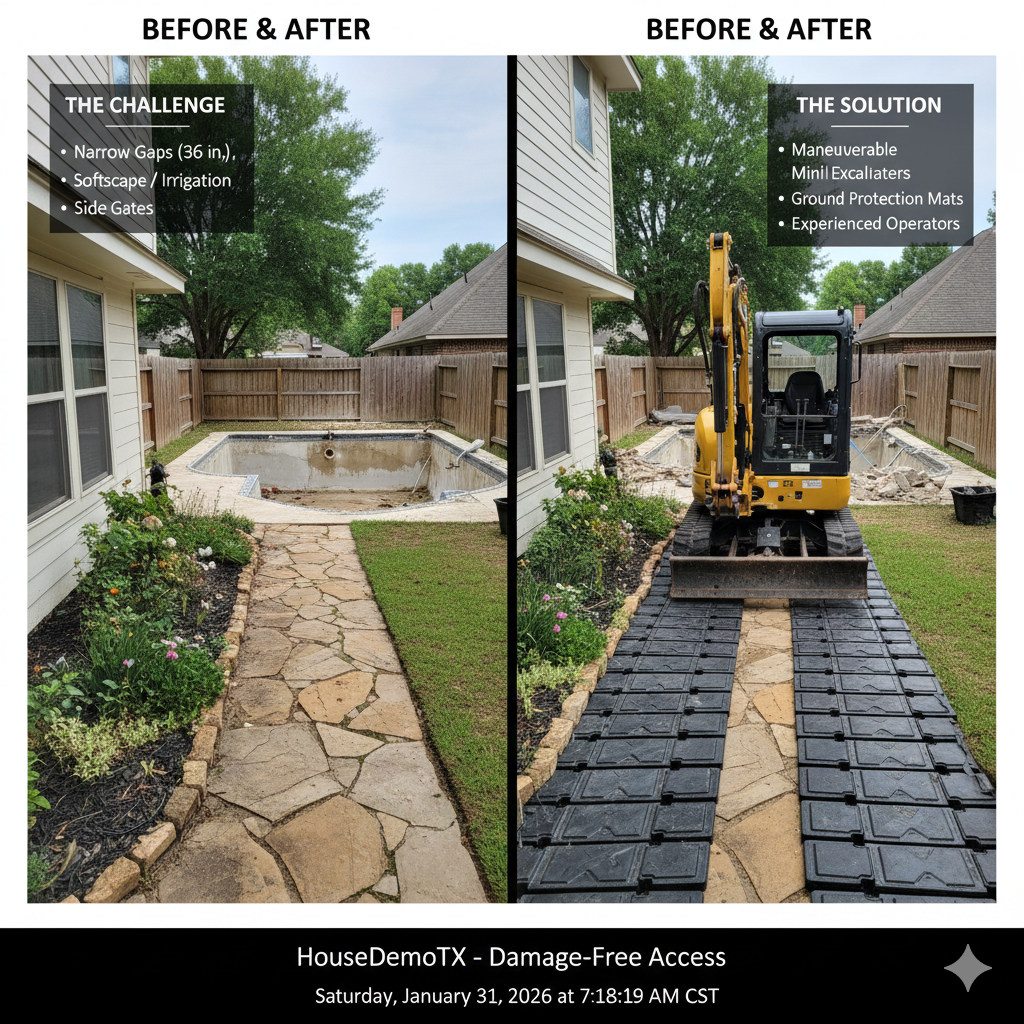
How We Get Heavy Machinery Into Small Backyards With Minimal Site Disruption
Many residential demolition projects look straightforward until you ask one question:
How is the equipment actually going to reach the structure or swimming pool?
Backyards can be surrounded by:
Fences
Gates
Houses
Garages
Trees
Landscaping
Utility lines
Septic systems
Patios
Driveways
Neighboring properties
A demolition contractor cannot simply assume that a full-size excavator can drive into every backyard.
Tight-access demolition requires planning around the property before equipment arrives.
HouseDemoTX performs residential demolition and swimming pool removal primarily throughout Beaumont and Southeast Texas, with selected projects throughout Greater Houston.
The goal is not to promise that heavy equipment will leave every property completely untouched.
The goal is to choose the right equipment, access route and demolition approach to reduce unnecessary disturbance while completing the work safely and efficiently.
Why Equipment Access Matters Before Demolition Begins
Equipment access can affect:
Which machines can be used
Whether a fence section must be removed
Where trucks or dumpsters can be positioned
How debris is transported
How long the project takes
Whether landscaping needs temporary protection
Whether smaller equipment is required
How much hand work is necessary
Project cost
Two nearly identical swimming pools can require very different demolition plans if one sits behind a wide driveway and the other is enclosed by a narrow side yard.
That is why access should be evaluated during estimating—not after the demolition equipment arrives.
What Equipment Is Used for Residential Demolition?
The specific equipment depends on the structure and property.
A residential demolition project may involve equipment such as:
Excavators
Mini excavators
Skid steers
Compact track loaders
Dumpsters
Dump trucks
Concrete-breaking attachments
Grapples
Buckets
Other demolition attachments
Larger machines can move material efficiently, but they also need more room.
Smaller equipment can sometimes reach constrained areas that a larger excavator cannot, although using smaller machines can affect production speed and debris handling.
The correct equipment should be selected based on the actual site.
Step 1: Measure the Access Route
The first step is determining how equipment can physically reach the work area.
Important measurements include:
Gate width
Side-yard width
Distance between the house and fence
Driveway width
Turning areas
Overhead clearance
Distance from the street to the backyard
Space around the demolition area
A homeowner can help considerably by sending photographs before the estimate.
Useful photos include:
The driveway
Both sides of the house
Backyard gates
Fences
Trees
The pool or structure
Neighboring structures
Utility equipment
The path from the street to the work area
For faster estimating, wide-angle photographs showing the entire access route are more useful than close-up pictures of only the structure being demolished.
Step 2: Look Above the Equipment Route
Access is not only about width.
Overhead obstacles can include:
Electrical lines
Communication lines
Tree limbs
Roof overhangs
Patio covers
Carports
Utility service drops
A route that appears wide enough at ground level may still be unsuitable if equipment cannot safely pass beneath overhead obstacles.
Known electrical and utility conditions should be identified before demolition begins.
For broader demolition planning, see:
Texas Homeowner Utility Disconnect Checklist
Step 3: Identify Underground and Ground-Level Obstacles
The surface of a backyard does not show everything underneath it.
Potential concerns can include:
Water lines
Sewer lines
Septic systems
Irrigation
Drainage pipes
Gas lines
Electrical service
Culverts
Old concrete
Buried structures
Property owners should tell the contractor about known underground systems before equipment moves across the property.
This is especially important on properties with septic systems or older utilities.
Step 4: Decide Whether a Fence Section Needs to Be Removed
Sometimes the easiest access route runs directly through an existing fence.
Options may include:
Using the existing gate
Temporarily removing a fence panel
Removing a wider fence section
Choosing a different access route
Using smaller equipment
The correct choice depends on the property.
If fence removal is required, the demolition estimate should clearly state whether:
The homeowner removes it
HouseDemoTX removes it
Reinstallation is included
Reinstallation is excluded
That prevents surprises after the demolition is complete.
Step 5: Match the Equipment to the Property
The largest available machine is not automatically the best machine.
For a tight-access property, smaller equipment may provide better control around:
Homes
Fences
Trees
Patios
Septic systems
Neighboring structures
The tradeoff is that smaller machines may require additional time to break, load and move material.
Equipment selection is therefore a balance between:
Access, production, control and site conditions.
Tight-Access Swimming Pool Removal
Swimming pool demolition is one of the most common situations where backyard access becomes a major part of the project.
Pools are often surrounded by:
Houses
Wooden fences
Masonry fences
Landscaping
Concrete decking
Outdoor kitchens
Patios
Trees
Neighboring homes
The demolition equipment must reach the pool, and demolished material must also get back out.
That second part matters.
Breaking the pool shell is only part of the project.
Concrete and other debris still need to be moved from the backyard to the loading or hauling area.
For complete pool-demolition information:
Swimming Pool Removal Services
For local service pages:
Swimming Pool Removal in Beaumont, TX
Swimming Pool Removal in Houston, TX
A Real Tight-Access Pool Removal in Bevil Oaks
HouseDemoTX has completed a documented pool-removal project in Bevil Oaks, Texas, where backyard access was one of the important project considerations.
Rather than relying on hypothetical neighborhood examples, homeowners can review the actual project here:
Bevil Oaks Tight-Access Pool Removal Project
Real project documentation is especially useful for tight-access work because photographs can show the relationship between equipment, structures and the available work area.
For another Southeast Texas pool-removal example:
Beaumont Gunite Pool Removal Project
Protecting Lawns and Finished Surfaces
Heavy equipment places significant weight on the ground.
Depending on the property, access planning may consider:
Existing lawn condition
Soil moisture
Ground firmness
Concrete driveways
Pavers
Decorative surfaces
Landscaping
Irrigation
There is no responsible way to promise that heavy-equipment demolition will never leave tracks, disturb grass or affect the access route.
A better approach is to identify sensitive areas before the project and discuss what can realistically be protected.
Property owners should also decide whether lawn restoration or landscaping is:
Included in the demolition scope
Handled separately
Not required
Wet Ground Can Change the Plan
Southeast Texas weather can make ground conditions an important factor.
Heavy rain can produce:
Soft soil
Mud
Standing water
Reduced equipment traction
Greater rutting risk
Difficult truck access
A route that works under dry conditions may not perform the same way after significant rainfall.
Weather can therefore affect both project timing and access strategy.
This does not mean every project must wait for perfectly dry weather, but ground conditions should be evaluated before repeatedly driving heavy equipment across the property.
What About Concrete Driveways?
A driveway can provide excellent equipment access, but property owners should not assume every driveway was designed for repeated heavy demolition traffic.
Factors include:
Concrete thickness
Existing cracks
Age
Subgrade condition
Equipment weight
Truck weight
Number of trips
If a driveway already has significant cracking or settlement, document its condition before the project begins.
Photographs taken before mobilization can help everyone understand what existed before demolition.
What About Trees?
Trees can reduce usable access width and overhead clearance.
Before removing or trimming anything, determine whether the tree actually interferes with:
Equipment movement
Excavator boom movement
Truck access
Debris loading
Safe separation from structures
Tree removal should not automatically be treated as part of demolition unless it is specifically included in the project scope.
What About Neighboring Houses?
Many residential demolition projects occur close to neighboring property.
Tight sites require attention to:
Property boundaries
Fence locations
Neighboring walls
Rooflines
Driveways
Vehicles
Landscaping
The demolition approach should reflect how close surrounding improvements are to the work area.
For house demolition in dense residential settings, equipment positioning and debris control become especially important.
Learn more:
Residential House Demolition Services
House Demolition in Beaumont, TX
House Demolition in Houston, TX
Tight Access Can Affect Project Cost
Yes.
Restricted access can change the scope because it may require:
Smaller machines
Additional machine time
Fence removal
More hand work
Longer material-haul routes
Additional loading steps
More trips
Specialized planning
For example, if a skid steer can load debris directly beside the pool, the workflow may be very different from a site where debris must be moved through a long narrow side yard before reaching a dumpster.
That is why accurate access photographs are important when requesting a quote.
Tight Access Can Affect the Demolition Method
The access route can also influence how demolition itself is performed.
For pool removal, it may affect:
Where concrete is broken
How material is moved
Where trucks or containers are positioned
How backfill reaches the excavation
For house demolition, it can affect:
Excavator positioning
Structure-removal sequence
Debris staging
Loading location
The contractor should plan the project around the site rather than forcing the same demolition method onto every property.
Full vs. Partial Pool Removal and Access
Access can also be relevant when choosing between full and partial pool removal.
Full removal generally involves removing more pool material from the property.
That can mean additional:
Demolition
Loading
Hauling
Backfill
Partial removal generally leaves portions of the pool structure below grade.
The appropriate method should be based on the property owner's goals, applicable requirements and intended future use—not simply which method is easiest for the equipment.
Read:
Partial vs. Full Pool Removal: Which Lasts Longer?
Backfill Must Also Reach the Backyard
Pool removal is a two-way logistics problem.
Demolition debris must leave.
Backfill material must come in.
On a constrained property, the contractor should consider how fill will move from the delivery area into the former pool excavation.
That may affect:
Equipment selection
Number of trips
Work sequence
Project duration
Backfill and grading should not be an afterthought.
For additional information about pool infill:
How Improper Pool Infill Can Cause Backyard Settlement Problems
How Homeowners Can Prepare for a Tight-Access Estimate
Before contacting a demolition contractor, take photographs of:
The street in front of the property
Driveway
Both sides of the house
Gate openings
Fence line
Backyard
Pool or structure
Overhead utility lines
Trees
Neighboring improvements
Any septic or known underground infrastructure
Areas you are particularly concerned about protecting
Also provide approximate measurements when possible.
Useful measurements include:
Gate width
Narrowest side-yard width
Distance between structures
Pool dimensions
Distance from driveway to work area
This information can help determine whether an on-site visit is needed before pricing.
Don't Hide Access Problems During Estimating
One of the easiest ways to create a bad demolition estimate is to show only the pool or structure and leave out the path equipment must use to reach it.
A contractor may see a straightforward demolition project from one photograph, only to discover later that access is restricted by a five-foot side yard, fence, tree or utility line.
Show the difficult parts upfront.
A more accurate estimate is better than a low estimate based on incomplete information.
What Should Be in a Tight-Access Demolition Scope?
Before work begins, clarify:
Equipment access route
Fence removal
Fence replacement, if any
Areas that should remain protected
Concrete or landscaping that should remain
Demolition method
Debris-loading location
Truck or dumpster location
Backfill route for pool projects
Final cleanup
Grading
Known utilities
Known septic infrastructure
The more clearly these items are defined, the fewer surprises there are during the project.
Does HouseDemoTX Guarantee Zero Property Damage?
No contractor using heavy demolition equipment should casually guarantee that a lawn, driveway or access path will look completely untouched after a major demolition project.
Our approach is to identify constraints before mobilization, choose equipment appropriate for the property and minimize avoidable disturbance wherever practical.
Some projects are naturally more disruptive than others.
The estimate and project discussion should establish realistic expectations before work begins.
Beaumont & Southeast Texas Tight-Access Demolition
Beaumont and Southeast Texas are HouseDemoTX's primary service area.
Residential properties in the region can range from open acreage to established neighborhoods with:
Narrow lots
Mature trees
Fences
Older driveways
Soft ground
Nearby houses
For local services:
Swimming Pool Removal in Beaumont, TX
House Demolition in Beaumont, TX
For actual Southeast Texas proof:
Bevil Oaks Tight-Access Pool Removal
Greater Houston Tight-Access Demolition
Greater Houston properties can present their own access challenges, particularly on residential lots with close neighboring structures, fences and limited backyard access.
HouseDemoTX accepts selected Greater Houston projects based on scope and location.
For Houston service information:
Swimming Pool Removal in Houston, TX
House Demolition in Houston, TX
Frequently Asked Questions
Can an excavator fit through a backyard gate?
Sometimes.
It depends on the machine and the actual gate opening.
If the gate is too narrow, options may include temporary fence removal, another route or smaller equipment.
Can you remove a pool if there is no wide backyard access?
Potentially.
Restricted access does not automatically prevent pool removal, but it can change equipment selection, project duration and cost.
Send photographs and measurements so the site can be evaluated.
Will heavy equipment destroy my lawn?
Heavy equipment can disturb grass and soft ground.
The amount of disturbance depends on equipment, soil, weather, traffic and the access route.
Discuss sensitive areas before work begins rather than relying on a promise that there will be no impact.
Can you work between houses?
Possibly, depending on available width, overhead clearance, utilities and equipment requirements.
Measurements and photographs are essential.
Do fences have to be removed?
Not always.
If the existing gate or another route provides adequate access, the fence may remain.
When temporary fence removal is required, it should be identified before work begins.
Does tight access make pool removal more expensive?
It can.
Restricted access may require smaller machinery, longer material-hauling routes, additional labor or extra handling.
Can heavy equipment drive over a septic system?
Known septic components should be identified before work begins.
Heavy equipment routes should be planned with known underground infrastructure in mind.
Can HouseDemoTX determine access from photos?
Photographs and measurements can answer many initial questions.
Some properties may still require an on-site evaluation before the final demolition approach is established.
The Bottom Line
Tight-access demolition is primarily a planning problem.
A backyard does not need highway-sized access for every project, but the contractor needs to understand:
How equipment will enter
What obstacles exist
How debris will leave
How fill will enter for pool projects
What the homeowner wants protected
Which equipment fits the property
What realistic site disturbance should be expected
The earlier those questions are answered, the easier it is to develop an accurate scope and estimate.
Request a Tight-Access Demolition Estimate
HouseDemoTX provides residential demolition primarily throughout Beaumont and Southeast Texas, with selected projects throughout Greater Houston.
For pool removal:
Swimming Pool Removal — Beaumont & Southeast Texas
Swimming Pool Removal — Greater Houston
Swimming Pool Removal Services
For house demolition:
House Demolition — Beaumont & Southeast Texas
House Demolition — Greater Houston
Residential House Demolition Services
See real project examples:
Bevil Oaks Tight-Access Pool Removal Project
Beaumont Gunite Pool Removal Project
For additional demolition planning:
For a faster estimate, send the property address, photographs of the demolition area, driveway and side-yard photos, gate-width measurements, pictures of overhead obstacles and any areas you are especially concerned about protecting.
Call HouseDemoTX at 832-981-2466.