We handle permits, inspections, utility coordination, demolition, and cleanup — so you don’t have to stress or guess

Will Homeowners Insurance Cover Mobile Home Demolition After Storm Damage?
Will insurance pay for storm-damaged mobile home demolition? Learn what affects coverage, what to document, and what to do before demolition in Texas.
MOBILE HOME DEMOLITION
1/30/20269 min read
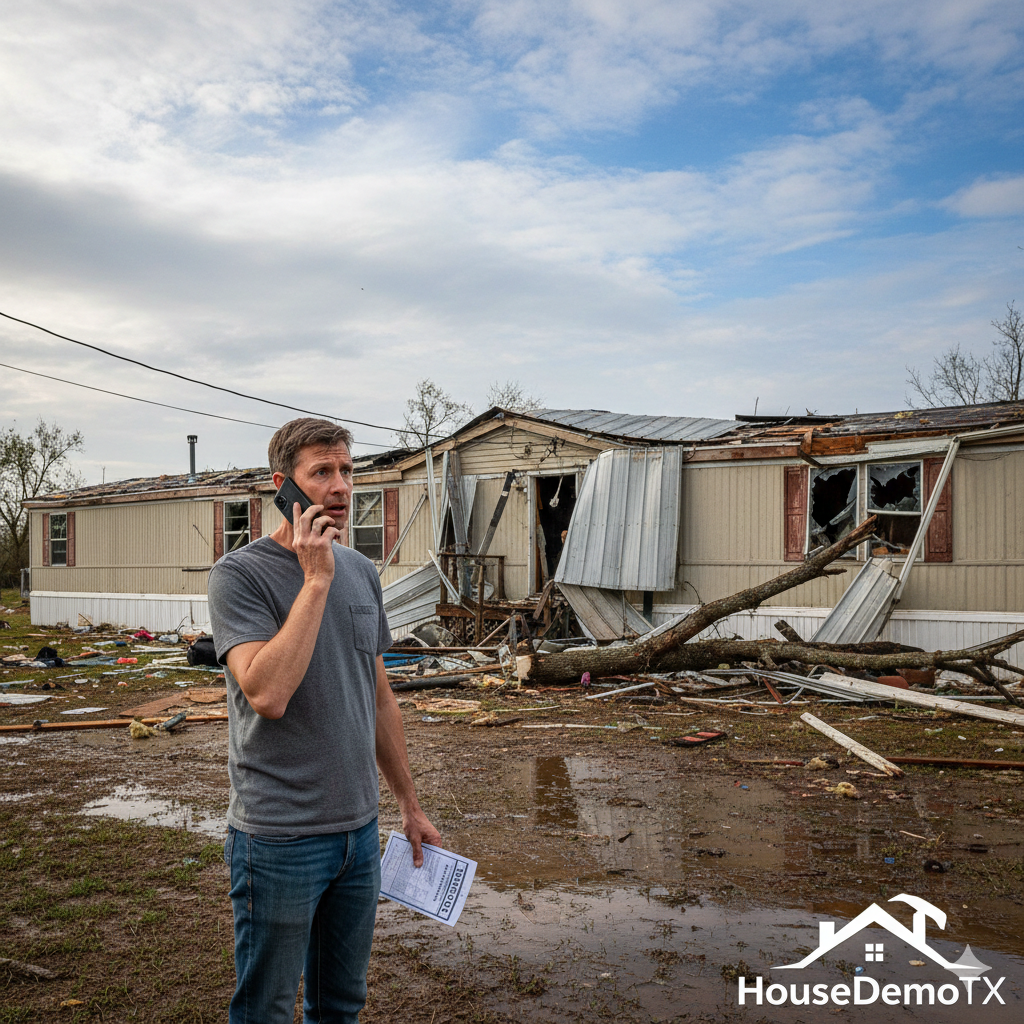
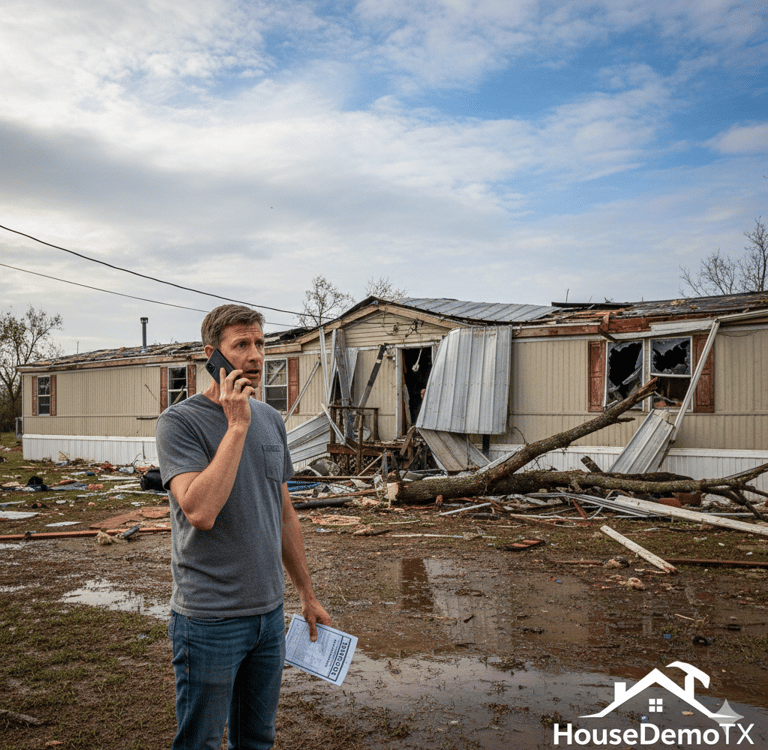
Will Insurance Cover Mobile Home Demolition After Storm Damage?
A hurricane, severe thunderstorm, tornado, falling tree, fire or other major event can leave a mobile or manufactured home so badly damaged that repair may no longer make practical sense.
That creates an important question:
Will homeowners or mobile home insurance pay for demolition and debris removal?
Sometimes—but there is no universal answer.
Insurance coverage depends on the cause of the damage, the policy that was in force, applicable exclusions, deductibles, coverage limits, how the insurer evaluates the loss, and whether demolition or debris removal falls within covered claim expenses.
Texas also treats mobile-home insurance as a distinct form of property insurance. The Texas Department of Insurance notes that mobile-home policies can cover the manufactured home, personal property, additional living expenses and liability, but the exact risks covered depend on the individual policy.
HouseDemoTX provides mobile home demolition and removal primarily throughout Beaumont and Southeast Texas, with selected projects throughout Greater Houston.
This guide explains what property owners should consider before authorizing demolition of a storm-damaged mobile home.
Important: HouseDemoTX does not determine insurance coverage, adjust claims or interpret insurance policies. Coverage decisions belong to your insurance carrier and the terms of your policy.
Does Insurance Automatically Pay for Mobile Home Demolition?
No.
The fact that a mobile home is damaged does not automatically mean an insurance company will pay to demolish it.
The first question is usually:
What caused the damage?
Texas Department of Insurance guidance explains that common home policies may cover losses from events such as fire, lightning and certain wind-related events, while flooding is generally excluded from standard home policies. Coastal properties can also have separate windstorm or hail coverage arrangements.
If demolition becomes necessary after a covered loss, some policies may provide some form of debris-removal or related coverage, but the amount and conditions vary by policy. Texas insurance filings illustrate that debris-removal provisions can be structured differently from one policy to another.
That is why the answer should come from the actual policy and adjuster, not from a contractor promising that insurance “will cover it.”
Storm Damage That May Lead to Mobile Home Demolition
A manufactured home may become a demolition candidate after severe damage involving wind, falling trees, fire, structural collapse or another destructive event.
The insurance question is separate from the demolition question.
A contractor can evaluate what it will take to remove the structure.
The insurer determines whether some or all of that work is covered under the claim.
For properties in Southeast Texas, the distinction between wind damage and flood damage can be especially important. Most standard home policies do not cover flood damage, and properties along parts of the Texas coast may need separate windstorm coverage.
What About Hurricane Damage?
“Hurricane damage” can involve more than one cause of loss.
For example, one storm could produce:
Wind damage from high winds.
Impact damage from a falling tree or flying debris.
Flood damage from rising water.
Those may not all be handled under the same insurance policy.
TDI specifically advises Texas homeowners to review their actual coverage because standard policies generally exclude flooding, while wind and hail coverage can also differ for coastal properties.
So instead of asking:
“Does my insurance cover hurricane demolition?”
ask your insurer:
“Which cause of loss damaged the manufactured home, which policy applies, and is demolition or debris removal included in the approved claim scope?”
Do Not Demolish the Home Before the Insurance Company Documents the Loss
This is one of the most important parts of the process.
After storm damage, TDI recommends notifying the insurance company promptly, taking photographs and video, preserving damaged items until the adjuster gives instructions, making reasonable temporary repairs to prevent additional damage, saving receipts, and avoiding permanent repairs before the adjuster has inspected the loss.
Demolition is obviously much more permanent than a normal repair.
Unless immediate safety conditions require emergency action, do not destroy the structure before confirming what your insurer needs to inspect or document.
If the home is unstable or dangerous, keep people away from it and tell the insurer about the safety condition immediately.
Before demolition, try to obtain written confirmation of what documentation the insurer wants preserved.
Photograph Everything Before Demolition
For a badly damaged manufactured home, documentation should be thorough.
Photograph or video the structure from multiple angles, including exterior damage, interior damage when safe to enter, roof damage, broken framing, water lines, fallen trees, damaged additions, porches, skirting, foundation components and debris around the property.
Also preserve photographs of the property before cleanup changes the scene.
TDI specifically recommends photographs and video after storm damage and advises policyholders not to discard damaged property until they have spoken with the adjuster.
Ask the Adjuster Whether Demolition Is Part of the Approved Scope
Do not assume that an insurer's decision that a manufactured home is a total loss automatically means every demolition expense is approved.
Ask specifically whether the claim addresses:
Structural demolition.
Debris loading and hauling.
Disposal.
Porches, decks or additions.
Foundation materials.
Slab, blocks, runners or piers.
Contents remaining inside.
Site cleanup.
Those can represent different pieces of the demolition estimate.
If concrete removal is not clearly addressed, read:
Do You Need to Remove the Concrete Slab After Mobile Home Demolition?
Is Debris Removal the Same as Demolition Coverage?
Not necessarily.
A policy may contain debris-removal provisions without automatically paying for every type of demolition or site work a property owner requests.
For example, an insurer might evaluate expenses associated with removing covered damaged property differently from optional grading, redevelopment, landscaping or removal of unrelated improvements.
Texas policy examples show that debris-removal coverage can also be subject to limits and can interact differently with the underlying property limit depending on the policy form.
For that reason, get clarity on the approved scope before assuming the insurance settlement will cover the entire contractor estimate.
What About Flood-Damaged Mobile Homes?
Flood deserves separate attention.
Most ordinary Texas home policies do not cover flood damage. Flood coverage generally requires separate insurance, such as a private flood policy or coverage through the National Flood Insurance Program.
That means a manufactured home damaged by rising water may have a very different insurance situation from one damaged primarily by wind.
If flooding contributed to the loss, contact the appropriate flood insurer as soon as possible rather than assuming the ordinary mobile-home or homeowners policy controls the entire claim.
What About Wind Damage in Southeast Texas?
Properties near the Texas coast can have additional insurance complications.
TDI states that homes on the Texas coast and certain properties near Galveston Bay may not have wind and hail included in their standard home policy. Separate coverage through the Texas Windstorm Insurance Association may apply in some situations.
For a storm-damaged property, identify which policy actually covers the claimed event before scheduling demolition.
That could mean dealing with one insurer for one type of damage and another policy for another cause of loss.
What If a Tree Fell on the Mobile Home?
Falling-tree damage can potentially be handled differently depending on whether the tree damaged covered property and what caused it to fall.
TDI says many policies cover damage from falling objects such as trees, while tree-removal coverage itself can depend on whether the tree damaged the home or blocked access. Property owners should confirm the specific situation with the carrier.
If the manufactured home itself has been seriously damaged, ask the adjuster whether the approved scope includes both the damaged structure and any related debris handling.
What If the Mobile Home Was Already in Poor Condition?
Pre-existing deterioration can complicate a claim.
Insurance generally evaluates damage according to policy terms and the covered event; ordinary wear and tear is typically treated differently from sudden covered damage. TDI lists wear and tear among conditions most standard home policies do not cover.
For example, a storm may damage a manufactured home that already had:
Roof deterioration
Rot
Existing structural movement
Long-term water damage
Abandoned contents
Prior fire damage
The insurer—not the demolition contractor—determines what portion of the claimed damage is covered.
Your contractor's job is to provide an accurate demolition scope.
What If the Mobile Home Is Considered a Total Loss?
A total-loss determination does not remove the need to understand the claim settlement.
Ask the adjuster how the policy handles:
The value of the manufactured home
Deductibles
Depreciation
Replacement-cost versus actual-cash-value provisions
Debris removal
Demolition expenses
Remaining personal property
Additional living expenses, if applicable
TDI explains that replacement-cost and actual-cash-value policies can produce significantly different settlements, and deductibles and coverage limits also affect what the insurer ultimately pays.
Do not use the demolition estimate alone to predict the insurance settlement.
Get a Detailed Demolition Estimate
When insurance is involved, a vague demolition quote is less useful than a clearly defined scope.
A useful estimate should distinguish what is actually being removed and what condition the site will be left in.
For example, the estimate may address the manufactured home, contents included in the scope, porches or additions, concrete, loading, hauling, disposal and final cleanup.
For additional pricing factors, see:
How Much Does Double-Wide Mobile Home Demolition Cost?
That guide explains why size alone does not determine demolition price.
What Information Should You Send a Demolition Contractor?
For a faster storm-damage estimate, provide:
Property address
Exterior photographs from all sides
Photographs of the storm damage
Interior photographs if the structure is safe to enter
Approximate manufactured-home size
Single-wide or double-wide
Photos of driveway and equipment access
Information about porches, decks or additions
Whether significant contents remain
Known utility status
Whether slabs, blocks, runners or piers should be removed
The insurer or adjuster's requested demolition scope, if available
What you want the property to look like when demolition is complete
The more clearly the project is defined, the easier it is to provide an estimate that the homeowner can discuss with the adjuster.
What About Utilities After a Storm?
Storm damage can create additional electrical, gas and utility hazards.
Do not enter or work around an unsafe manufactured home simply to document utilities.
Before mechanical demolition begins, the applicable utility requirements should be addressed for the property and jurisdiction.
For general planning information:
Texas Homeowner Utility Disconnect Checklist
What If You Want Another Manufactured Home on the Property?
Insurance-funded removal of the damaged home and preparation for a replacement home are not necessarily the same scope.
After demolition, the property may still contain:
Old blocks or piers
Runners
Slab material
Utility components
Debris
Drainage issues
Grading needs
If another manufactured home is planned, determine what needs to be removed now and what the future installer will require.
Read:
Preparing Your Lot for a New Manufactured Home After Demolition
Do not assume that demolition automatically makes a lot approved or engineered for a replacement home.
What If the Storm-Damaged Mobile Home Is Abandoned?
A damaged structure can also involve ownership issues when the manufactured home has been abandoned, inherited, left by a former tenant or located on land owned by someone else.
Resolve ownership and authority to demolish before the structure is removed.
Related guide:
Abandoned Mobile Homes: Demolition Considerations for Property Owners and Landlords
Insurance coverage and legal authority to demolish are separate questions.
Beaumont & Southeast Texas Storm-Damaged Mobile Home Demolition
Beaumont and Southeast Texas are HouseDemoTX's primary service area.
Storm-damaged properties in this region can involve wind, heavy rain, flooding, falling trees and other severe-weather conditions. The insurance treatment depends on the actual cause of loss and the policies covering the property. Texas insurance guidance makes the distinction between ordinary home coverage, flood coverage and coastal wind coverage especially important.
For local demolition information:
Mobile Home Demolition in Beaumont, TX
For broader service information:
Mobile Home Demolition & Removal Services
Greater Houston Storm-Damaged Mobile Home Demolition
HouseDemoTX also accepts selected mobile-home demolition projects throughout Greater Houston.
The exact demolition and permitting requirements depend on the property's jurisdiction and project scope.
For Houston-area service information:
Mobile Home Demolition in Houston, TX
A Real Southeast Texas Mobile Home Demolition Project
To see a documented manufactured-home demolition rather than a generic stock example, review:
Nederland Double-Wide Mobile Home Demolition Project
For additional completed work:
HouseDemoTX Demolition Projects
What Should You Do After Storm Damage?
The safest sequence is straightforward.
First, protect people. Stay out of an unstable or unsafe structure.
Second, notify the insurer. Report the loss promptly.
Third, document the property. Take extensive photographs and video before permanent work begins.
Fourth, ask what the adjuster needs. Determine whether an inspection, photographs, contractor estimate or other documentation is required before demolition.
Fifth, obtain a demolition estimate. Make sure the estimate clearly defines what will be removed.
Sixth, confirm the approved insurance scope. Do not assume every portion of the contractor estimate is covered.
Seventh, authorize demolition only when the insurance/documentation requirements and property-safety issues have been addressed.
TDI similarly recommends prompt claim reporting, photographic documentation, temporary loss-prevention measures and avoiding permanent repairs until the adjuster has had an opportunity to review the damage.
Frequently Asked Questions
Will homeowners insurance pay to demolish a storm-damaged mobile home?
It may, depending on the policy, cause of loss and approved claim scope.
There is no automatic rule that all demolition costs are covered.
Does mobile home insurance cover storm damage?
Coverage depends on the policy and the cause of the damage. Texas insurance guidance notes that mobile-home policies are available for manufactured homes, while flood and some coastal wind risks may require separate coverage.
Does insurance cover debris removal?
Some property policies include debris-removal coverage, but provisions and limits vary. Ask the insurer specifically how demolition debris is handled under your policy.
Will regular homeowners insurance cover flood demolition?
Do not assume so.
Most standard Texas home policies exclude flood damage, so separate flood insurance may apply.
Should I demolish the mobile home before the adjuster arrives?
Generally, avoid permanent demolition before the insurer has had an opportunity to document the loss unless immediate safety requirements make emergency action necessary.
TDI advises homeowners not to make permanent repairs before an adjuster sees storm damage and to preserve documentation.
Should I get a demolition quote before the insurance company approves the claim?
A detailed quote can help establish the demolition scope, but obtaining an estimate does not mean the insurer has agreed to pay it.
Send the quote to the adjuster and ask what portions, if any, are approved under the claim.
Can HouseDemoTX tell me whether insurance will cover my demolition?
No.
HouseDemoTX can evaluate the demolition property and provide a project scope and estimate.
Your insurer determines coverage.
The Bottom Line
Insurance may cover some or all of the demolition of a storm-damaged mobile home—but never assume coverage before checking the policy and claim.
The strongest process is to:
document the loss, contact the insurer promptly, allow the adjuster to evaluate the damage, obtain a detailed demolition estimate, confirm what expenses the insurer has approved, and then schedule demolition.
This protects the insurance claim while giving the demolition contractor a clear scope of work.
Request a Storm-Damaged Mobile Home Demolition Estimate
HouseDemoTX provides mobile-home demolition primarily throughout Beaumont and Southeast Texas, with selected projects throughout Greater Houston.
Start with:
Mobile Home Demolition — Beaumont & Southeast Texas
Mobile Home Demolition — Greater Houston
Mobile Home Demolition & Removal Services
Additional resources:
Double-Wide Mobile Home Demolition Cost Guide
Should You Remove the Concrete Slab?
Preparing a Lot for a Replacement Manufactured Home
Nederland Double-Wide Demolition Project
For a demolition estimate, send the property address, photographs showing the damage, approximate home size, equipment-access photographs, information about remaining contents and any demolition scope requested by the insurer or adjuster.
Call HouseDemoTX at 832-981-2466.