We handle permits, inspections, utility coordination, demolition, and cleanup — so you don’t have to stress or guess

Should You Demolish Your Pool? The Numbers Say “Yes” More Often Than You Think (Water • Liability • Land Value)
Swimming pool demolition is moving from “cosmetic backyard change” to a measurable risk + operating-cost decision. Why now: New pool construction has cooled sharply—only ~60,000 residential in-ground pools expected in 2024, about half of 2021, signaling a shift toward repair, remodel, and removal work. The U.S. has an enormous installed base—~10.7 million pools—so even a small “end-of-life” wave becomes a real market. Water and energy costs are becoming board-level topics for municipalities and homeowners alike; “nice-to-have” infrastructure is being re-evaluated. Here’s the part most homeowners miss: the pool decision isn’t just about whether you like swimming. It’s about whether the pool still makes sense as an asset when you price in water, energy, safety exposure, and future land use.
SWIMMING POOL REMOVAL
3/21/20264 min read
Should You Demolish Your Pool? The Numbers Say “Yes” More Often Than You Think (Water • Liability • Land Value)
Trend
Swimming pool demolition is moving from “cosmetic backyard change” to a measurable risk + operating-cost decision.
Why now:
New pool construction has cooled sharply—only ~60,000 residential in-ground pools expected in 2024, about half of 2021, signaling a shift toward repair, remodel, and removal work.
The U.S. has an enormous installed base—~10.7 million pools—so even a small “end-of-life” wave becomes a real market.
Water and energy costs are becoming board-level topics for municipalities and homeowners alike; “nice-to-have” infrastructure is being re-evaluated.
Here’s the part most homeowners miss: the pool decision isn’t just about whether you like swimming. It’s about whether the pool still makes sense as an asset when you price in water, energy, safety exposure, and future land use.
Problem
Most “pool removal horror stories” don’t come from the demolition itself—they come from skipping the engineering thinking around it.
Three common failure modes:
1) The hidden operating cost (even when nobody swims)
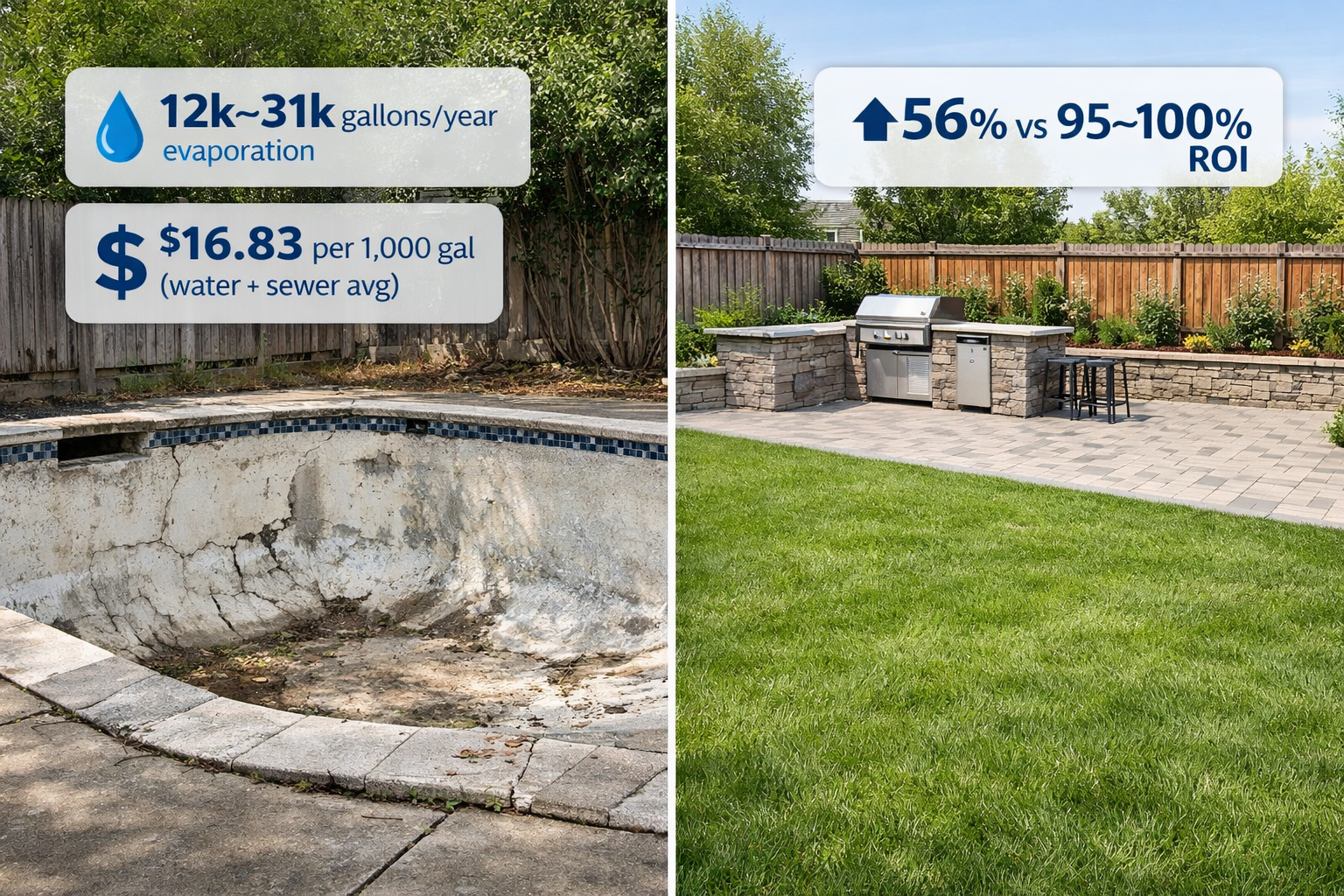
A typical uncovered 500 sq ft pool can lose 12,000–31,000 gallons/year to evaporation. Using WaterSense’s 2024 national average combined water + wastewater rate of $16.83 per 1,000 gallons, that evaporation alone is roughly:
12,000 gallons → $201.96/year
31,000 gallons → $521.73/year
That’s before splash-out, backwashing, leaks, or refills.
Add electricity: DOE notes a pool pump can consume up to a few thousand kWh/year, costing as much as ~$270/year in utility bills.
So even a lightly-used pool can quietly rack up $500–$1,000+/year in baseline water + pump energy, depending on climate and local rates—without counting chemicals, cleaning, repairs, or heating.
2) The “repair cliff” (when the pool hits end-of-life)
Pools don’t age gracefully. When plaster, tile, coping, decking, lines, and equipment start failing, many owners face a “spend big or reset the yard” moment.
Market pricing data for a remodel commonly lands in the four- to five-figure range, and once you start stacking repair items, it’s easy to pour money into a feature you don’t use enough.
Solution
A simple, quantitative decision model
If you’re trying to decide between repairing a pool and removing it, don’t debate it emotionally. Run it like a capex decision.
Step 1 — Price the next 5 years of keeping it
Add up:
Baseline water loss (use the evaporation range + your local water/sewer rate)
Pump electricity (plus heating if applicable)
Routine maintenance (service or DIY supplies)
The big repair you know is coming (resurface, leak, deck, equipment, etc.)
Step 2 — Price the reset
Full removal pricing often falls in a range that’s surprisingly competitive with a single major repair cycle.
Example scenarios that justify demolition (fast):
Scenario A: “The Repair Cliff”
You’re staring at a major remodel (surface + tile + equipment). If that repair package rivals the cost of full removal, demolition becomes the rational option—because it also removes future operating costs and future repair risk.
Scenario B: “I want the land back”
You want an outdoor kitchen, patio expansion, fire feature, garden, sport court, ADU path, or simply a usable yard.
NAR’s outdoor remodeling data shows cost recovery varies massively by project:
In-ground pool addition: ~56%
New patio: ~95%
Outdoor kitchen: ~100%
Overall landscape upgrade: ~100%
Translation: if you’re going to invest in the yard, the data suggests many owners recover more value by putting dollars into patios + landscape functionality than into pools—especially older pools with visible wear.
Scenario C: “Safety exposure changed”
New child in the home, grandkids visiting, frequent neighborhood kids, renters, or parties. If your risk profile changed, removal is the most definitive control.
Scenario D: “Water economics finally matter”
With WaterSense’s national rate benchmark, evaporation alone can represent $200–$522/year. In higher-rate areas, it gets worse. When you add electricity and service, your pool can become a recurring operating cost that competes with other household priorities.
Partial fill-in vs full removal (choose based on future use)
Partial fill-in can be cost-effective for landscaping-only plans, but it can limit future building and requires the right drainage/compaction approach.
Full removal is the “cleanest” option for true reuse—especially if there’s any chance you’ll want a slab, structure, or hardscape later.
Controls
This is what a professional swimming pool demolition quote should include (and what separates a real demolition contractor from “a guy with an excavator”):
Administrative controls (avoid rework + permit issues)
Permit pathway (demo/abandonment requirements vary by jurisdiction)
Utility locate + shutoff plan (electric, gas, irrigation, lighting)
Water discharge plan (don’t create a compliance problem on day one)
Disposal/recycling plan for concrete/steel and documentation trail (future resale is smoother when you can prove the work)
Engineering controls (avoid settlement + drainage problems)
Defined demolition scope: decking, shell, plumbing, equipment pad, fencing/rails
Drainage intent: eliminate “bathtub effect” and prevent ponding in the old footprint
Backfill strategy: clean material, placed in lifts, compacted with a plan (and optional testing when future construction is planned)
Dust control and safe demolition practices (cutting/breaking concrete isn’t just noise—it’s a real health exposure if unmanaged)
The big idea: You’re not paying for “dirt in a hole.” You’re paying for a build-ready yard with controlled risk.
If you’re even considering inground pool removal, here’s the fastest way to get an apples-to-apples quote:
Send us:
Pool type (gunite/concrete, vinyl, fiberglass) + rough dimensions
3 photos showing access (gate width, slopes, tight turns)
Your end goal (lawn only vs patio vs future structure)
Your city/ZIP (permits vary)
We’ll return a clear, itemized recommendation—partial fill-in vs full removal—and a scope you can compare against any bidder. We believe that our 1st priority is to help you make a well informed decision in choosing the right service, with the right contractor, at the right time.
Get a quote / scope review:
https://housedemotx.com/swimming-pool-removal
Hashtags
#SwimmingPoolDemolition #PoolRemoval #IngroundPoolRemoval #ConcreteDemolition #ResidentialDemolition #SiteWork #BackfillAndCompaction #ConstructionRisk #WaterEfficiency #OutdoorLiving