We handle permits, inspections, utility coordination, demolition, and cleanup — so you don’t have to stress or guess

Preparing Your Lot for a New Manufactured Home After Demolition
Replacing an old mobile home? Learn what to consider after demolition, including slabs, utilities, drainage, grading, access and site preparation in Beaumont and Houston.
MOBILE HOME DEMOLITION
1/30/202610 min read

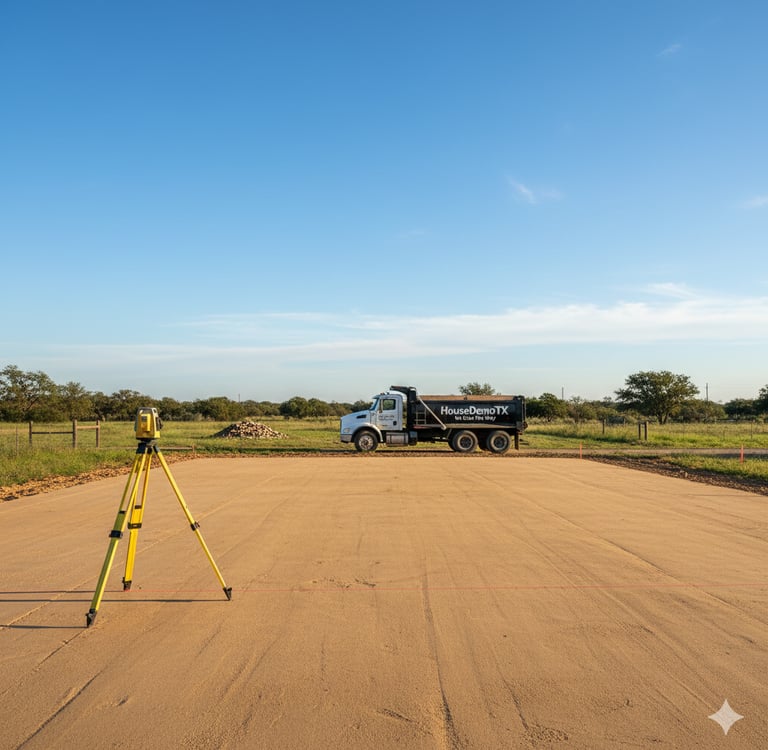
Preparing Your Lot for a New Manufactured Home After Demolition
Removing an old mobile or manufactured home is often only the first step.
If you plan to install another manufactured home on the property, decisions made during demolition can affect how much cleanup, concrete removal, grading and other work will be needed before the replacement home arrives.
The most important question is not:
“Can the new home go where the old one was?”
It is:
“What condition does the replacement-home installer need this property to be in?”
HouseDemoTX provides mobile home demolition and removal primarily throughout Beaumont and Southeast Texas, with selected projects throughout Greater Houston.
Our demolition scope can include removal of the old manufactured home, debris, porches, additions, blocks, runners, slabs and final lot cleanup depending on what the property owner wants removed.
The company responsible for installing the new manufactured home should determine the specific site, foundation, drainage, anchoring and installation requirements for that replacement home.
Start With the Replacement Home Before Finalizing Demolition
If you already know another manufactured home will be installed, talk to the replacement-home dealer or installer before deciding what to leave behind.
That conversation can prevent unnecessary work later.
For example, you need to know whether the installer wants:
Existing concrete removed
Old runners preserved or removed
Blocks and piers cleared
A specific area opened for new foundation work
Utility connections preserved at particular locations
Access maintained for delivery equipment
Additional grading completed before installation
An existing slab or utility location may look reusable but may not match the requirements of the new home.
The demolition contractor should therefore clear the site according to the agreed demolition scope—not guess what the new home will require.
Step 1: Remove the Old Manufactured Home Completely
A clean transition begins with clearly defining what is being demolished.
The scope may include more than the mobile home itself.
Older properties often have attached or nearby improvements such as porches, decks, carports, ramps, sheds, room additions and skirting.
If those improvements will interfere with the replacement home, include them in the demolition scope from the beginning.
Likewise, abandoned furniture, appliances and household debris should be identified during estimating because they add material that must be loaded, hauled and handled.
For a detailed explanation of the factors that affect demolition pricing, read:
How Much Does Double-Wide Mobile Home Demolition Cost?
Step 2: Decide What Happens to the Old Slab, Runners, Blocks and Piers
This is one of the most important decisions on a replacement-home project.
Manufactured homes can sit on different types of support systems, including concrete runners, blocks, piers, pads or larger slabs.
Do not assume the existing foundation material should stay simply because another manufactured home will occupy the property.
The replacement home's dimensions, foundation system and installation plan may be different.
Old concrete may also have:
Cracking
Settlement
Damage
Poor alignment
Unwanted elevations
Drainage problems
Locations that conflict with the new layout
If the replacement-home installer says the existing material is unnecessary, removing it while demolition equipment is already on the property can be more efficient than bringing equipment back later.
For a complete discussion, read:
Do You Need to Remove the Concrete Slab After Mobile Home Demolition?
Should You Automatically Remove All Existing Concrete?
No.
Existing concrete should be evaluated based on the property's future use.
Some concrete may remain useful as a driveway, parking area, patio or other surface.
Other concrete may interfere with the new home or future grading.
The key is to decide intentionally.
Before demolition begins, identify exactly:
What stays? What goes?
That should be reflected in the contractor's written scope.
Step 3: Remove Demolition Debris From the Future Home Area
A replacement-home site should not inherit buried demolition debris from the old structure.
The demolition process can produce:
Wood
Metal
Roofing
Siding
Insulation
Interior finishes
Concrete
Blocks
Fasteners
Household contents
The project scope should address proper debris removal rather than simply pushing unwanted material around the property.
A clean demolition area gives the replacement installer a much clearer site to evaluate.
Step 4: Think About the Finished Grade
After demolition, the site may need grading depending on what was removed.
Removing a manufactured home, slab, runners or other concrete can leave:
Low areas
Uneven ground
Excavated areas
Equipment tracks
Disturbed soil
The demolition contractor and property owner should agree on what final cleanup or grading is included.
There is an important distinction between:
Demolition grading — leaving the property reasonably clean and shaped after demolition.
and:
Replacement-home installation preparation — preparing the property to the specifications required for the new manufactured home.
Those are not automatically the same thing.
HouseDemoTX should not describe a property as certified, engineered or guaranteed “build-ready” unless that exact scope has actually been provided by the appropriate qualified party.
For broader lot-clearing and grading services, see:
Step 5: Pay Attention to Drainage
Drainage should be considered before a replacement home is installed.
Removing an old structure can change how water moves across the property, particularly when slabs, runners, porches or other concrete are also removed.
Look for conditions such as:
Existing low areas
Standing water
Runoff from neighboring property
Downhill drainage paths
Ditches or swales
Areas disturbed by demolition equipment
Water collecting where the old home stood
The final drainage requirements for the replacement manufactured home should be confirmed by the responsible installer and any other appropriate professionals.
The demolition phase should avoid creating obvious drainage problems that make the next stage harder.
Step 6: Locate and Evaluate Existing Utilities
An old manufactured-home site may already have connections for:
Electricity
Water
Sewer
Septic
Natural gas
Propane
Communications
Those existing connections can be useful—but they should not automatically be assumed suitable for the replacement home.
The new home may have a different:
Footprint
Utility-entry location
Electrical requirement
Plumbing layout
Sewer connection point
Septic configuration
Before demolition, determine which utility components should be:
Disconnected, protected, removed or preserved.
This is especially important when demolition equipment will be working near buried or above-ground utility infrastructure.
For demolition-related planning, see:
The Texas Homeowner Utility Disconnect Checklist
The replacement-home installer and applicable utility professionals should determine what connections will ultimately be required for the new home.
Step 7: Protect Delivery Access
A demolition site may be easy for an excavator to reach but difficult for a large manufactured-home delivery operation.
If another home will be delivered soon, think about access before changing the property.
Consider:
Driveway width
Gates
Trees
Fences
Overhead utility lines
Neighboring structures
Culverts
Ditches
Soft ground
Turning space
Where demolition debris containers or trucks will operate
Do not remove or alter access features without considering how the replacement home will eventually reach the site.
Likewise, don't assume the demolition contractor should determine whether a delivery route is suitable for the new home.
Ask the manufacturer, dealer, transporter or installer responsible for delivery.
Step 8: Tell the Demolition Contractor Exactly What Comes Next
A property being cleared for another manufactured home may require a different demolition scope from one being converted into an empty lot.
When requesting an estimate, tell HouseDemoTX:
“Another manufactured home will be installed here after demolition.”
That immediately raises useful planning questions.
Should the old slab remain?
Should the concrete runners be removed?
Should the blocks and piers be removed?
Do porches and additions need to disappear?
Are there utilities the owner wants preserved?
Does the replacement installer already have a site plan?
Does the owner want rough grading after demolition?
The sooner those questions are answered, the less likely the property owner is to pay for duplicate work.
Do Not Assume the Old Foundation Will Work for the New Home
Even when the replacement home is similar in size, its installation requirements may differ from those of the structure being demolished.
The old home may have been installed:
Decades ago
Under different requirements
With a different footprint
Using a different support system
At a different elevation
With additions that changed the original site
The replacement-home installer should evaluate what can legitimately be reused.
HouseDemoTX can remove unwanted foundation materials as part of the demolition scope, but the demolition contractor should not certify an old foundation for the new home unless appropriately qualified and specifically contracted to do so.
Do You Need Soil Testing?
That decision should be made based on the replacement home's installation requirements and property conditions—not through a blanket demolition rule.
A demolition contractor may encounter areas of disturbed soil while removing slabs or buried materials, but determining foundation suitability for the replacement manufactured home belongs to the professionals responsible for the new installation.
If the installer, engineer or other appropriate professional requires testing or specific fill preparation, obtain those requirements before final site preparation.
This avoids the mistake of performing generic work first and then learning the replacement installer requires something different.
What About Compaction?
Compaction matters when fill is placed, but the required method and acceptance criteria depend on what the area will be used for and the specifications governing the future work.
HouseDemoTX should therefore avoid promising a universal compaction percentage for every replacement-home project.
Instead, the sequence should be:
The replacement-home installer or appropriate professional establishes what is required.
The property owner communicates those requirements.
The demolition/site-preparation scope is written accordingly.
Testing or certification is performed only when it is actually part of the contracted work.
That is much more useful than advertising every demolished property as automatically “build-ready.”
Should You Preserve the Old Utility Connections?
Possibly.
If the new manufactured home will occupy approximately the same area, some utility infrastructure may remain useful.
But do not preserve an old connection simply because it exists.
Before deciding, determine:
Whether the connection is still active
Whether its location works for the new home
Whether it is in acceptable condition
Whether the appropriate utility professional or installer can reuse it
Whether demolition equipment can safely work around it
Sometimes preserving infrastructure saves work.
Sometimes it restricts demolition and later has to be replaced anyway.
The replacement-home plan should drive the decision.
What If the Property Uses a Septic System?
A septic system deserves special attention during demolition and site planning.
If the existing system will remain, the property owner should identify known components and avoid unnecessary heavy-equipment traffic over sensitive areas.
If the replacement home changes bedroom count, location, plumbing layout or other site conditions, additional evaluation may be needed outside the demolition scope.
HouseDemoTX's job is to understand where known site infrastructure is located so demolition can be planned appropriately.
The professional responsible for the future wastewater system should determine what the new home requires.
What About Manufactured-Home Ownership Records?
Demolition and installation are separate events, and manufactured homes can have ownership records that should be addressed when a home is dismantled or destroyed.
Before demolition, confirm that you have legal authority to remove the existing manufactured home and that any ownership or lien issues have been resolved.
Your local mobile-home service page explains this in greater detail:
Mobile Home Demolition in Beaumont, TX
For Greater Houston:
Mobile Home Demolition in Houston, TX
What If the Existing Mobile Home Is Storm-Damaged?
Storm-damaged properties may have an additional layer of planning.
Before removing the structure, property owners should consider whether an insurance carrier or adjuster needs documentation of the damaged home.
Demolition is permanent, so photographs, claim documentation and the approved scope should generally be addressed before the structure disappears.
Read:
Will Insurance Cover Mobile Home Demolition After Storm Damage?
Once insurance and ownership issues have been addressed, the replacement-home planning process can continue.
A Real Southeast Texas Mobile Home Demolition
HouseDemoTX completed a documented double-wide manufactured-home demolition in Nederland, Texas.
That project provides a real example of residential manufactured-home removal, debris handling and final cleanup in Southeast Texas.
See the project:
Nederland Double-Wide Mobile Home Demolition Project
You can also review:
HouseDemoTX Demolition Projects
Real project documentation is useful when evaluating a demolition contractor because it shows actual work rather than hypothetical neighborhood examples.
Preparing a Replacement-Home Lot in Beaumont & Southeast Texas
Beaumont and Southeast Texas are HouseDemoTX's primary service area.
For a property where another manufactured home will eventually be installed, we can discuss a demolition scope that may include:
Single-wide or double-wide removal
Porches and additions
Blocks and piers
Concrete runners
Slab removal
Debris hauling
Utility coordination related to demolition
Final cleanup
Grading or additional site-preparation work when included in the scope
The replacement-home installer should separately determine what the new home requires before installation.
For local service information:
Mobile Home Demolition in Beaumont, TX
Preparing a Replacement-Home Lot in Greater Houston
HouseDemoTX also accepts selected manufactured-home demolition projects throughout Greater Houston.
Houston-area properties can vary significantly by jurisdiction, access, utilities, lot configuration and demolition scope.
A Houston mailing address also does not automatically determine which permitting authority applies to a property.
For local demolition information:
Mobile Home Demolition in Houston, TX
For overall service information:
Mobile Home Demolition & Removal Services
Replacement Manufactured Home Site-Planning Checklist
Before the old manufactured home is demolished, answer these questions:
Have you selected the replacement home?
Has the replacement-home installer reviewed the property?
Do you know what foundation or support material should remain?
Should the old slab, runners, blocks or piers be removed?
Are porches, decks, additions and sheds also being removed?
Are there existing utilities worth preserving?
Do you know where septic or other buried infrastructure is located?
Will the replacement home use the same part of the property?
Is there enough delivery and equipment access?
Does the demolition estimate clearly state the desired final condition?
Is grading included?
Does the replacement installer require additional site work after demolition?
If you cannot answer several of those questions, involve the replacement-home installer before finalizing the demolition scope.
Frequently Asked Questions
Can I put a new manufactured home where the old one was?
Possibly, but the replacement-home installer should evaluate whether that location is suitable for the new home and installation system.
Do not assume the previous home location automatically satisfies the requirements of the replacement home.
Can the old concrete slab be reused?
Sometimes existing concrete may remain useful, but its suitability for a replacement manufactured home should not be assumed.
See:
Should You Remove the Mobile Home Slab After Demolition?
Does HouseDemoTX make the property “build-ready”?
HouseDemoTX can perform the demolition, debris removal, concrete removal, cleanup and agreed site-preparation work.
We do not use “build-ready” to imply that a property has automatically been engineered, approved or certified for installation of a replacement manufactured home.
The responsible replacement-home professionals determine what installation work is required next.
Should I remove the old blocks and piers?
If the replacement installer does not intend to reuse them and your goal is a clean site, include them in the demolition scope.
Should utilities stay in place?
Only when preserving them makes sense for the replacement plan and they can be safely protected during demolition.
Coordinate that decision before demolition begins.
Does the site need to be perfectly level after demolition?
The final condition depends on the agreed demolition and site-preparation scope.
The finished installation requirements for the replacement home should be provided by the party responsible for installing it.
Can HouseDemoTX remove the mobile home and slab at the same time?
Yes, slab or other concrete removal can be included when requested and reflected in the project scope.
What should I send for an estimate?
Send the property address, exterior photographs, equipment-access photographs, approximate home size, photographs of existing concrete and additions, and a description of what you want removed.
If you already have information from the replacement-home installer, include that as well.
The Bottom Line
If another manufactured home will replace the old one, plan the demolition around what comes next.
The strongest sequence is:
Choose or discuss the replacement home.
Have the responsible installer identify important site requirements.
Define what old structures and concrete should remain or be removed.
Clarify utilities and access.
Then write the demolition scope around those decisions.
HouseDemoTX can remove the existing manufactured home and leave the property in the agreed condition for the next phase.
What we should not do is promise that every demolished lot is automatically engineered, certified or ready for a new manufactured home simply because the old structure is gone.
Clear scope now prevents expensive surprises later.
Request a Mobile Home Demolition & Site Preparation Estimate
HouseDemoTX provides mobile-home demolition primarily throughout Beaumont and Southeast Texas, with selected projects throughout Greater Houston.
Start with the service area that applies to your property:
Mobile Home Demolition — Beaumont & Southeast Texas
Mobile Home Demolition — Greater Houston
For complete service information:
Mobile Home Demolition & Removal Services
Related planning resources:
Double-Wide Mobile Home Demolition Cost Guide
Do You Need to Remove the Concrete Slab?
Texas Utility Disconnect Checklist
Nederland Double-Wide Demolition Project
Completed HouseDemoTX Projects
For a faster estimate, send the property address, photographs of the existing manufactured home, pictures of access and existing concrete, approximate home size, and any site instructions already provided by the replacement-home installer.
Call HouseDemoTX at 832-981-2466.