We handle permits, inspections, utility coordination, demolition, and cleanup — so you don’t have to stress or guess

How to Save Your Trees During a Full Site Clearing (2026 Guide)
How to Save Your Trees During a Full Site Clearing (2026 Guide)
HOUSE DEMOLITIONDEMOLITION
1/30/20262 min read
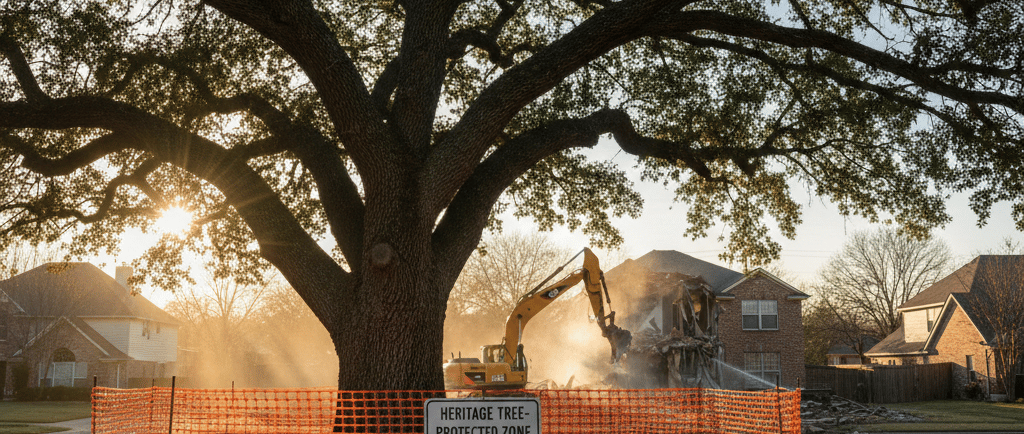
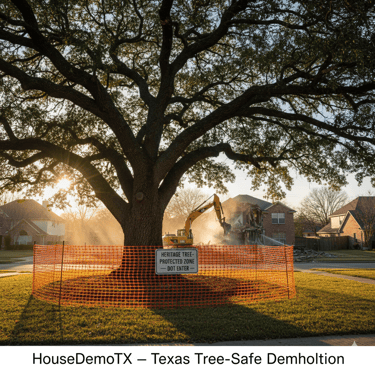
How to Save Your Trees During a Full Site Clearing (2026 Guide)
When you are clearing a lot for a new build, it is easy to focus on the structures coming down. However, the most valuable assets on your property aren't the buildings—they are the mature Oaks, Elms, and Pecans. In 2026, a single heritage tree can add up to $20,000 in property value to your new home.
At HouseDemoTX, we specialize in "Surgical Site Clearing." We don't just bulldoze; we protect. Here is the professional protocol for keeping your trees alive and healthy during a heavy house demolition.
1. Understand the "Critical Root Zone" (CRZ)
The biggest mistake homeowners make is thinking a tree is safe as long as the trunk isn't hit. In reality, a tree’s "organs" are its roots, which extend far beyond the canopy (the drip line).
The Rule of Thumb: For every inch of trunk diameter, you must protect a 1.5-foot radius of ground. A 20-inch wide Oak requires a 30-foot "No-Go Zone."
The Threat: Heavy machinery like excavators and skid steers compact the soil. This "smothers" the roots by cutting off oxygen and water, leading to a tree that dies 2–3 years after your new house is finished.
2. Mandatory Protective Fencing
In 2026, cities like Austin and San Antonio require "Tree Protection Fencing" to be installed before a demolition permit is finalized.
Material: Fencing should be at least 4 feet tall and made of high-visibility orange mesh or, ideally, chain link for high-traffic sites.
Placement: The fence must be placed at the edge of the Critical Root Zone.
Zero Entry: No materials, debris, or portable toilets should ever be placed inside this fenced area.
3. Dealing with Low-Hanging Branches
Excavators are tall. To prevent a machine from "tearing" a limb—which creates an entry point for diseases like Oak Wilt—you must perform "Pre-Demo Pruning."
Professional Cuts: Have a certified arborist clean-cut any limbs lower than 15 feet.
Wound Dressing: In many parts of Central Texas, any cut on an Oak tree must be painted immediately to prevent the nitidulid beetle from spreading Oak Wilt.
4. Mitigation During the Demo
If a machine must cross a root zone to access the house, HouseDemoTX utilizes "Root Bridging":
Mulch Armoring: We lay 8–12 inches of wood chips over the root zone to distribute the weight of the machinery.
Steel Plating: For extremely heavy loads, we use temporary steel plates to prevent soil compaction.
5. Summary: The 2026 Tree Protection Checklist
[ ] Identify Heritage Trees: Any tree over a certain diameter (varies by city) requires a permit to remove.
[ ] Install CRZ Fencing: Secure the perimeter before the first truck arrives.
[ ] Prohibit Soil Grade Changes: Don't pile dirt against a tree trunk; it causes rot.
[ ] Post-Demo Hydration: Demolition is dusty and dries out the soil. Water your protected trees deeply after the site is cleared.
Build Your Future Under the Shade
A lot is just dirt; a lot with mature trees is a "Homesite." At HouseDemoTX, we take pride in clearing the way for your new home while respecting the natural beauty of your land.