We handle permits, inspections, utility coordination, demolition, and cleanup — so you don’t have to stress or guess

How Improper Pool Infill Causes Backyard Sinkholes (And How We Avoid It)
How Improper Pool Infill Causes Backyard Sinkholes (And How We Avoid It)
SWIMMING POOL REMOVAL
1/30/20262 min read
How Improper Pool Infill Causes Backyard Sinkholes (And How We Avoid It)
If you’ve ever seen a yard with a mysterious, circular depression where a pool used to be, you’re looking at a failed infill. In Texas, our unique soil conditions—ranging from expansive Blackland Prairie clay to Gulf Coast sand—make "dumping and jumping" (dumping dirt and hoping for the best) a recipe for disaster.
At HouseDemoTX, we treat every swimming pool removal as an engineering project. Here is the science of why backfills fail and the "Lifts & Drainage" protocol we use to prevent sinkholes forever.
1. The "Bathtub Effect": Why Holes Are Mandatory
The #1 cause of backyard sinkholes isn't actually the dirt—it's the water. If a contractor performs a partial pool removal and leaves the bottom of the concrete shell intact, they’ve created an underground bathtub.
The Physics: Rainwater percolates through the new soil, hits the concrete bottom, and has nowhere to go. This creates a "slurry" of mud beneath your lawn.
The Result: As the mud shifts or escapes through tiny cracks, the surface soil collapses into the voids.
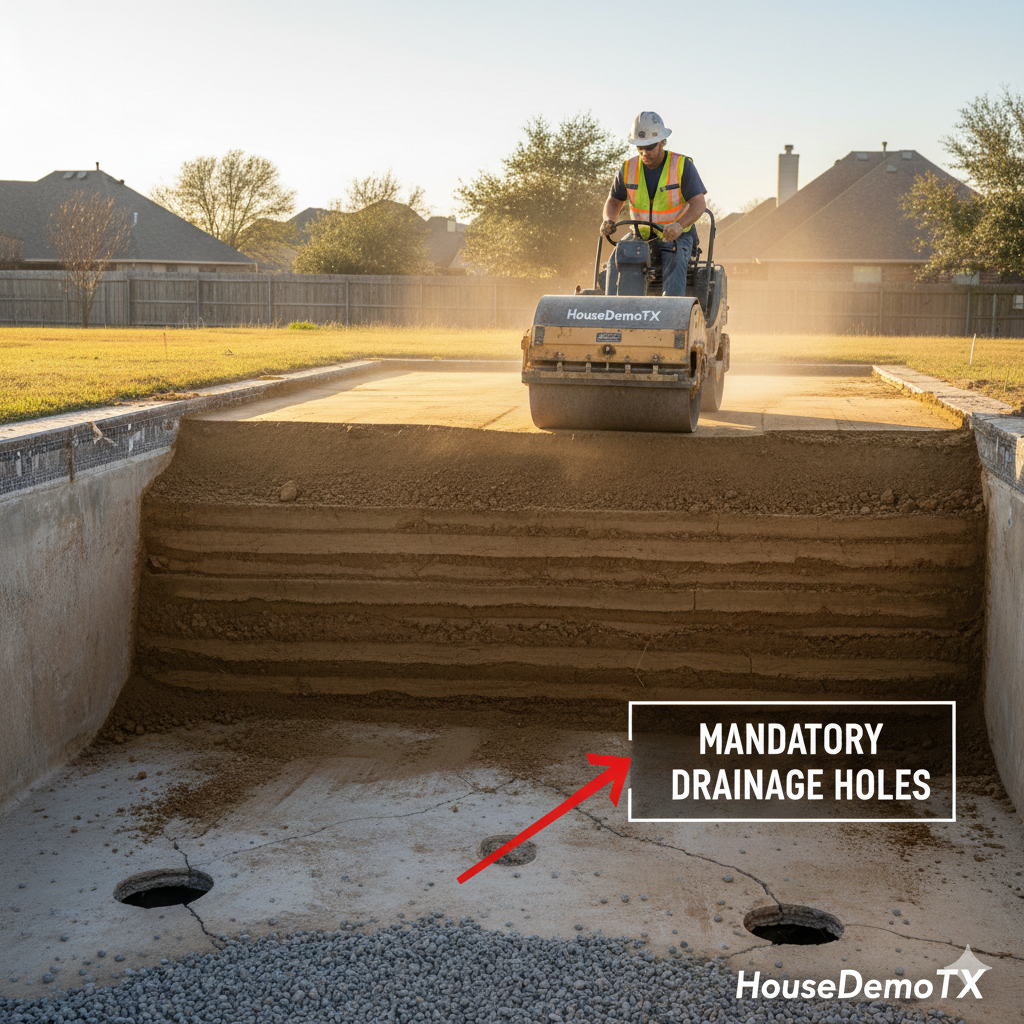
The HouseDemoTX Fix: We use heavy-duty jackhammers to punch massive drainage holes (minimum 3-foot diameter) every few feet in the floor of the shell. This ensures water moves through the soil and into the aquifer, not into your lawn.
2. Soil Compaction: The "8-Inch Lift" Rule
You cannot fill an 8-foot deep hole in one go. If you dump 8 feet of loose dirt, air pockets are guaranteed. Over the next 24 months, those air pockets will "burp" (Yes, I Said Burp) to the surface, causing the ground to drop.
The Professional Standard: We backfill in 8-inch "lifts." We add a layer of soil, use a vibrating plate compactor or a trench roller to achieve 95% proctor density, and then repeat the process.
The Result: The soil is packed as tightly as the "undisturbed" earth around it, meaning your yard stays level for decades.
3. Organic Debris: The Silent Killer
Some "budget" crews will try to save money on haul-off fees by throwing old fence wood, tree stumps, or even pieces of the pool liner into the bottom of the hole before covering it with dirt.
The Problem: Organic material rots. As the wood decays over 5–10 years, it leaves a hollow space underground.
The Result: A sudden sinkhole that appears years after the contractor has disappeared.
Our Policy: We have a "Zero Organics" rule. Only clean fill dirt and engineered crushed stone enter the cavity.
4. The 2026 Material Mix: Beyond Just Dirt
In 2026, we’ve found that a "one-size-fits-all" soil approach doesn't work for Texas. Depending on your location, we customize the fill:
Gravel Base: We often start with 12 inches of crushed stone at the very bottom to facilitate rapid drainage.
Select Fill: We use a specific ratio of clay and sand that resists the extreme "shrink-swell" cycles typical of Houston and Austin summers.
5. Summary: 3 Signs Your Contractor Is Cutting Corners
If you are getting bids for a pool removal, red flags include:
No mention of compaction equipment (tampers or rollers).
Using "Free Fill" (which is often full of trash, roots, or large rocks).
No drilling of drainage holes in the pool floor.
Don't Let Your Backyard Become a Liability
A sinkhole is more than an eyesore; it’s a trip hazard and a threat to your property value. HouseDemoTX provides a Compaction Guarantee with every project, ensuring your new lawn is as solid as the day it was first graded.