We handle permits, inspections, utility coordination, demolition, and cleanup — so you don’t have to stress or guess

Do You Need to Remove the Concrete Slab of a Mobile Home?
Should you remove the concrete slab after mobile home demolition? Learn when to keep or remove slabs, runners, piers and blocks in Beaumont and Houston.
MOBILE HOME DEMOLITION
1/30/20268 min read
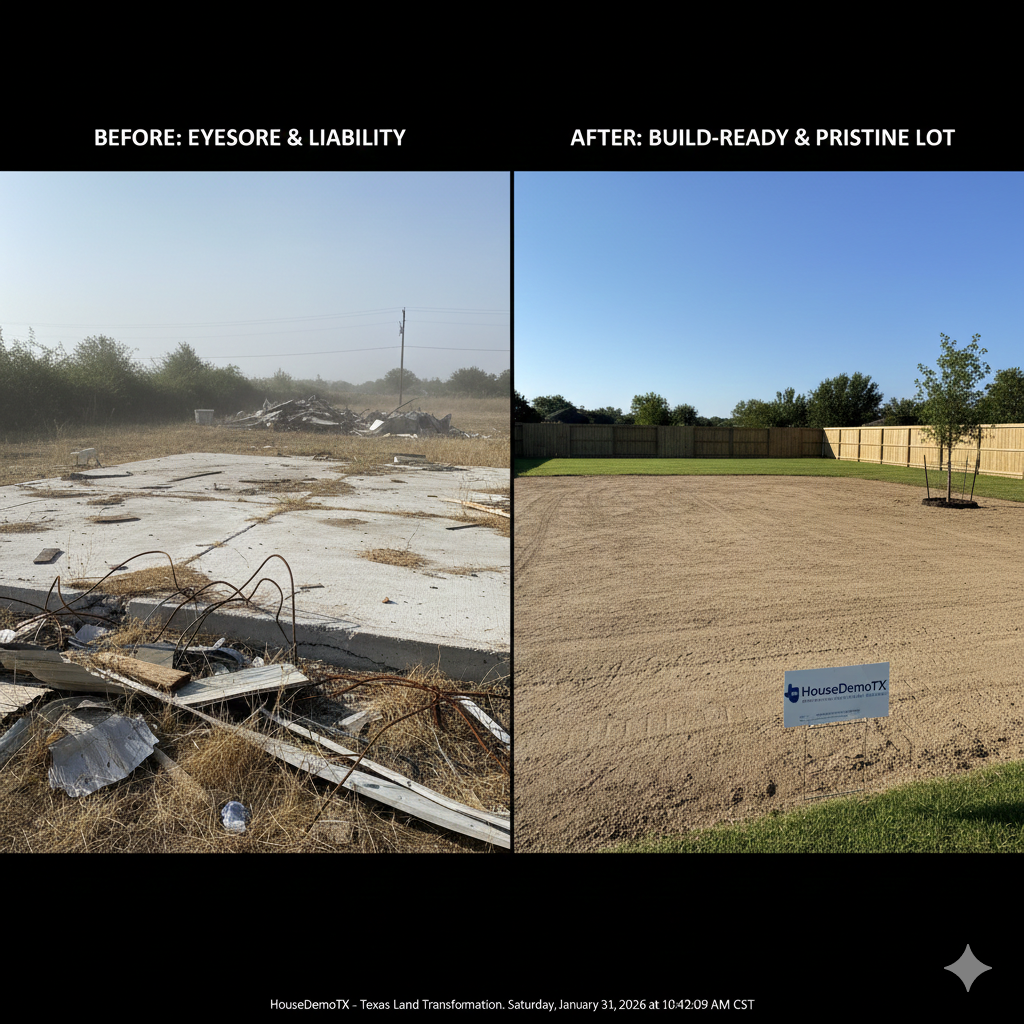
Do You Need to Remove the Concrete Slab After Mobile Home Demolition?
When an old mobile or manufactured home is demolished, one important decision remains:
Should the concrete slab, runners, blocks or other foundation material stay—or should they be removed too?
There is no single answer for every property.
The right decision depends on:
What type of foundation or concrete is actually present
Its condition
What the property will be used for next
Drainage and grading
Utility locations
Whether another manufactured home will be installed
Whether a house or other structure is planned
The additional demolition and hauling cost
HouseDemoTX provides mobile home demolition and removal primarily throughout Beaumont and Southeast Texas, with selected projects throughout Greater Houston.
This guide explains when concrete should usually be considered for removal, when leaving it may make sense, and what property owners should decide before demolition begins.
Does Every Mobile Home Sit on a Full Concrete Slab?
No.
Mobile and manufactured homes can be supported in several different ways.
A property may have:
Individual concrete blocks
Piers
Concrete runners or strips
Small pads
A full slab
Concrete porches
Driveways
Patios
Carport slabs
Combinations of several systems
That means “remove the slab” may describe very different scopes from one property to another.
Before demolition begins, identify exactly what concrete and support material exists and which parts should remain.
For general mobile-home demolition information, see:
Mobile Home Demolition & Removal Services
Is Concrete Removal Automatically Included in Mobile Home Demolition?
Not necessarily.
The demolition estimate should clearly state whether the scope includes:
Manufactured-home structure
Skirting
Porches
Additions
Blocks or piers
Concrete runners
Full slab
Driveway
Steps
Other concrete
Debris removal
Final grading
Do not assume that “mobile home demolition” automatically means every piece of concrete on the property will be removed.
Likewise, do not assume that concrete must be removed simply because the home is being demolished.
The correct scope depends on what you plan to do with the property afterward.
When Should You Consider Removing the Concrete?
The Slab Is Cracked or Deteriorated
Old concrete may have:
Major cracks
Uneven settlement
Broken edges
Significant deterioration
Drainage problems
Damage from roots or previous repairs
If the concrete has little future value and is already in poor condition, removing it while demolition equipment is on the property may make more sense than paying for a second demolition project later.
You Want a Clean, Open Lot
If the goal is to sell, landscape or repurpose the property as an open lot, abandoned concrete may work against that goal.
Removing unused slabs, runners and pads can create a cleaner starting point for:
Lawn
Landscaping
Drainage improvements
Future site planning
Property cleanup
The finished scope should be discussed before demolition begins so the estimate reflects the desired result.
The Concrete Is in the Way of Future Plans
A slab that worked for an old manufactured home may not match the layout or requirements of what comes next.
Future plans might include:
Another manufactured home
A site-built house
Garage
Workshop
Storage building
Driveway changes
Landscaping
Property sale
Do not assume an existing slab can simply be reused for a future structure.
Whether existing concrete is suitable should be determined by the appropriate installer, designer, engineer, building professional or local authority for the proposed project.
The Concrete Is Causing Drainage Problems
Concrete can affect how water moves across the property.
If an abandoned slab:
Holds water
Redirects runoff
Creates low areas
Interferes with grading
removal may make it easier to establish a better finished site.
This is particularly worth evaluating before spending money landscaping around concrete you may later decide to remove.
When Might It Make Sense to Leave the Concrete?
Concrete does not always have to be demolished.
You Have a Specific Future Use for It
An existing concrete area might still be useful for:
Parking
Equipment storage
Patio space
Walkways
Other nonstructural uses
provided its condition and location make sense for that purpose.
The Owner Wants to Minimize the Demolition Scope
Concrete demolition adds:
Equipment time
Labor
Debris volume
Loading
Hauling
Disposal
Leaving usable concrete in place can reduce the demolition scope when the owner has a legitimate reason to keep it.
Future Plans Are Not Yet Known
If you do not yet know what will happen with the property, keeping sound concrete may sometimes be reasonable.
But consider the potential cost of removing it later.
Removing a slab while demolition equipment and hauling resources are already mobilized may be simpler than arranging a separate concrete-removal project months later.
Can an Old Mobile Home Slab Be Reused for a New Manufactured Home?
Do not assume that it can.
The old concrete may not match the new home's:
Dimensions
Support locations
Foundation design
Installation system
Elevation
Drainage requirements
Its condition also matters.
An old slab or runner system could have cracking, settlement or other conditions that are not obvious from the surface.
If another manufactured home will be installed, discuss the existing foundation with the company responsible for the new installation before deciding to preserve it.
For a broader planning discussion, see:
Preparing Your Lot for a New Manufactured Home After Demolition
That article should be treated as planning guidance rather than a guarantee that any particular lot is ready for a new installation.
What If I Plan to Build a House Later?
If a site-built house is planned, do not assume the old mobile-home slab is suitable as a new residential foundation.
Foundation requirements depend on the proposed structure, soil, engineering, design, local requirements and other property-specific conditions.
The better approach is to tell the demolition contractor that future construction is being considered.
That way you can decide whether removing old concrete now would make the future project easier.
For additional demolition and lot-clearing options, see:
What About Concrete Runners?
Many manufactured-home sites do not have one continuous slab.
Instead, they may have concrete runners or strips beneath portions of the structure.
Whether to remove them depends on the same basic questions:
Are they still useful?
Are they in good condition?
Do they interfere with grading?
Will another home use the same layout?
Will future construction require a different foundation?
Does the owner want a completely cleared site?
Make sure runners are specifically included in the demolition quote if you want them removed.
What About Blocks and Piers?
Blocks and piers are often easier to overlook because they may remain under the structure or become mixed into the demolition area.
If the goal is a clean lot, specify whether these should also be removed.
Otherwise, the contractor may reasonably interpret the project as removal of the manufactured-home structure only.
Your Beaumont and Houston mobile-home service pages already allow slabs, blocks, porches and additions to be included based on the requested final condition of the property.
What About Porches, Steps and Carport Slabs?
These should be discussed separately.
An old mobile-home site can contain significant concrete that is technically not part of the home's original foundation.
Examples include:
Front porch slabs
Rear patios
Steps
Sidewalks
Carport slabs
Shed pads
Ask:
Do I want this concrete after the mobile home is gone?
If the answer is no, it is usually better to identify it during estimating rather than after demolition is complete.
Does Concrete Removal Increase Mobile Home Demolition Cost?
Usually, additional concrete removal increases the project scope.
Concrete is heavy and requires additional:
Breaking
Loading
Equipment time
Hauling
Disposal or recycling
But the actual effect on price depends on the amount, thickness, access and site conditions.
This is another reason a mobile-home demolition estimate should be based on the entire property rather than a generic cost-per-square-foot formula.
For more about demolition pricing, see:
How Much Does Double-Wide Mobile Home Demolition Cost?
Should You Remove the Slab Before Selling the Property?
It depends on what a likely buyer wants to do with the land.
Leaving usable concrete may be helpful for some buyers.
For others, an abandoned slab represents:
Additional demolition expense
An obstacle to redevelopment
An unwanted remnant of the old structure
If you are clearing the property specifically to market it as an open residential lot, discuss the final condition with your real-estate professional and demolition contractor.
A cleaner site can be easier for buyers to evaluate, but removing concrete does not guarantee a higher sale price.
What Happens After the Concrete Is Removed?
The next step depends on the project scope.
After concrete demolition, work can include:
Removing broken material
Hauling debris
Filling low areas
Rough grading
Establishing reasonable surface drainage
Preparing the lot for its next phase
Do not automatically describe the site as “build-ready” after demolition.
Demolition and grading are different from engineering, foundation design, manufactured-home installation approval or building approval.
The intended use of the property should determine what additional work is required after demolition.
Utility Lines May Affect the Decision
Before removing old concrete, consider whether utilities pass:
Beneath it
Through it
Alongside it
The property may contain:
Electrical service
Water
Sewer
Septic lines
Gas or propane components
Communication lines
Utility status and location should be addressed before excavation or concrete removal.
For additional planning information, read:
The Texas Homeowner Utility Disconnect Checklist
A Real Southeast Texas Mobile Home Demolition
HouseDemoTX completed a documented double-wide mobile-home demolition in Nederland, Texas.
The project involved controlled demolition, debris loading and hauling inside a mobile-home community. Approximately 230 cubic yards of demolition debris were removed, and the project was completed over two days.
See the complete project:
Nederland TX Double-Wide Mobile Home Demolition Project
For additional completed work:
HouseDemoTX Demolition Projects
Beaumont & Southeast Texas Mobile Home Demolition
Beaumont and Southeast Texas are HouseDemoTX's primary service area.
When requesting an estimate, tell us whether you want:
Mobile home only
Blocks and piers removed
Concrete runners removed
Full slab removed
Porches removed
Additions removed
Final lot cleanup
Grading included
The more clearly the finished condition is defined, the more accurately the demolition scope can be established.
For local service information:
Mobile Home Demolition in Beaumont, TX
Greater Houston Mobile Home Demolition
HouseDemoTX also accepts selected mobile-home demolition projects throughout Greater Houston.
Houston-area requirements can vary depending on the exact jurisdiction. Your current Houston service page correctly distinguishes between properties inside the City of Houston and properties that may fall under another jurisdiction such as unincorporated Harris County.
For local service information:
Mobile Home Demolition in Houston, TX
Questions to Answer Before Demolition
Before approving the scope, decide:
Is there a full slab, runners, piers or blocks?
What concrete belongs to the mobile home versus patios, carports or other improvements?
Is the concrete damaged?
Do I have a future use for it?
Will another manufactured home be installed?
Is site-built construction planned?
Does the concrete interfere with drainage?
Do I want the property completely cleared?
Are utilities located near or below the concrete?
Is concrete removal specifically included in the estimate?
Those questions prevent one of the most common misunderstandings in demolition:
The structure is gone, but the property owner expected the concrete to be gone too.
Frequently Asked Questions
Do you have to remove a mobile home slab after demolition?
No universal rule says every slab must be removed simply because the mobile home is demolished.
The decision depends on the slab's condition, future property use, project requirements and the owner's goals.
Is slab removal part of mobile home demolition?
It can be, but it should be specifically included in the project scope.
Ask the contractor to identify which slabs, runners, blocks, piers and other concrete are included.
Should I keep the old slab for another mobile home?
Only after confirming that preserving it makes sense for the proposed replacement home and installation plan.
Do not assume an old slab will automatically be suitable.
Can you remove just the mobile home and leave the concrete?
Yes, if that is the agreed scope and leaving the concrete is appropriate for the property.
Is it cheaper to leave the slab?
Leaving concrete generally reduces the amount of demolition, hauling and disposal compared with removing it.
However, if the slab later has to be removed for redevelopment, delaying the work can create a separate future project.
Does removing the slab make the lot ready to build on?
Not automatically.
Concrete removal can clear the site, but future building suitability can depend on grading, fill, soils, engineering, foundation design, permits and the proposed structure.
What should I send for an estimate?
Send:
Property address
Photos of the mobile home
Photos of the slab, runners or blocks
Photos of porches and additions
Equipment-access photos
Approximate mobile-home size
What concrete you want removed
What you plan to do with the property afterward
The Bottom Line
You do not automatically have to remove every concrete slab after mobile-home demolition.
But old concrete should not be left behind by accident.
Remove it when it is damaged, unwanted, interfering with drainage or future plans, or when your goal is a fully cleared lot.
Consider leaving it when it remains useful and you have a specific reason to keep it.
Most importantly:
Define the final condition of the property before the demolition estimate is approved.
That is the best way to prevent confusion over slabs, blocks, runners, porches and other concrete after the mobile home is gone.
Request a Mobile Home Demolition Estimate
HouseDemoTX provides mobile-home demolition primarily throughout Beaumont and Southeast Texas, with selected projects throughout Greater Houston.
Start here:
Mobile Home Demolition — Beaumont & Southeast Texas
Mobile Home Demolition — Greater Houston
Mobile Home Demolition & Removal Services
Related resources:
Double-Wide Mobile Home Demolition Cost Guide
Preparing a Lot for a New Manufactured Home
Nederland Double-Wide Demolition Project
Completed HouseDemoTX Projects
For a faster estimate, send the property address, exterior photographs, access photos, approximate home size and photos showing the concrete or foundation material you want removed.
Call HouseDemoTX at 832-981-2466.